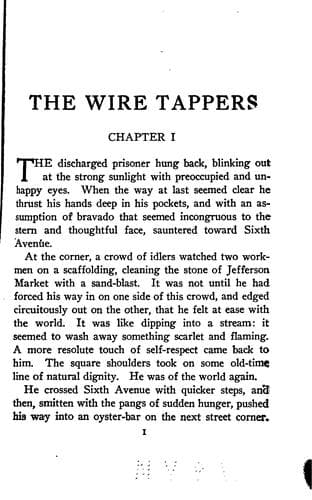
Canadian fiction; Criminals -- Fiction; Man-woman relationships -- Fiction
Again their eyes met. She had to struggle desperately to keep down the
inward horror of it all. And now above all things there must be no
missteps.
“Yes,” she murmured.
“When?” he demanded.
“I’ll come back—tomorrow!”
She already had her hand on the door-handle, when he called to her
sharply.
“Here, wait one minute!”
She paused, in some deadly new fear of him.
“Look here, little girl, I began to follow this business of mine when I
was nineteen years old. I’m forty-three now, and in those twenty-four
years I’ve hauled in a heap of money. Are you listening?”
“Yes,” she murmured.
“And I’ve hauled in something besides money!”
Still she waited.
“What I haven’t made by plunging I’ve made by poker. And I’d never have
come out the long end if I didn’t know a thing or two about faces. I
know a bluff when I see it. Now I want to tell you something.”
“Well?” she faltered.
“You’re not comin’ back tomorrow! You’re not comin’ back at all, my
pink-and-white beauty! I’m tellin’ you this for two reasons. One is that
I don’t want you to carry off the idea that you’ve been breakin’ me all
up, and the other is that I’m not so rotten bad as—well, as Bob
Pinkerton would try to make me out. That’s all.”
“Good-bye!” murmured the humbled woman from the doorway.
“Good-bye, and good luck!” answered Sunset Bryan in his genial bass.
CHAPTER XXII
For all the rest of that day Frances Candler hated herself, hated Durkin
for the mean and despicable paths into which he and his plottings had
forced her, hated her sordid and humiliating conquest of the gambler
Bryan and his secret.
But most of all she hated what she saw was happening within herself, the
insidious and yet implacable hardening and narrowing of all her nature,
the accumulating of demeaning and corroding memories, the ripening of a
more and more morose self-contempt into a vague yet sullen malevolence
of thought and wish.
She told herself, forlornly, that she still would not let her better
nature die without a struggle, for all that she had done, and for all
that she had been through. What crushed and disheartened her was the
conviction that this struggle once more, in the end, would prove a
futile one. She was not bad, though, not all bad, like women she had
known! She had always aspired and turned toward what was right and
good—her spirit cried out desolately. It was not that she had gained
anything through all her wrong-doing. From the first, she felt, she had
been the tool in some stronger hand; she had been only the leaf on the
winds of some darker destiny. At first it had been to live, and nothing
more. Now it was to love—only some day to love as she had always hoped
to do; not at once to win the crown, but some day to hope to be able to
win that crown. For this she was surrendering her womanhood, her
integrity of soul, even the last shred of her tattered self-respect.
Public-domain text, read in full here on John Shaqi.
Reviews
Reviews
No reviews yet
Be the first to share your thoughts on this work.
Elsewhere in the archive
Join the Discussion
Join the discussion
Sign in to leave a comment or review.
Sign InorCreate an account