Canadian fiction; Criminals -- Fiction; Man-woman relationships -- Fiction
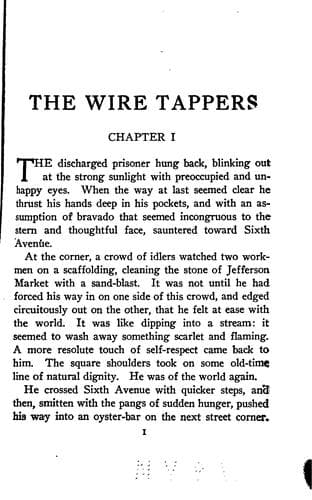
There was neither sign nor token, in the faces of the citied throng that
brushed past him, to show that any of life’s more tumultuous emotions
and movements had touched their lives. It was only as he passed a
newsboy with his armful of flaring headlines, and a uniformed officer,
suggestive of the motley harvest of a morning police court, that once
more he fully realized how life still held its tumult and romance,
though it was the order of modern existence that such things should be
hidden and subterranean. It was only now and then, Durkin told himself,
through some sudden little explosion in the press, or through the
steaming manhole of the city magistrate’s court, that these turgid and
often undreamed of sewers showed themselves. . . . After all, he
maintained to himself, life had not so greatly altered.
CHAPTER XXVI
Durkin’s first feeling, incongruously enough, once he was out in the
open air, was a ravenous sense of hunger. Through all that busy day his
only meal had been a hasty and half-eaten breakfast.
His second thought was at once both to submerge and sustain himself in
one of those Broadway basement restaurants where men perch on seats and
gulp down meals over a seat-fringed counter.
Then he thought of Frances, of her anxiety, of her long waiting, and he
tried to tell himself, valiantly enough, that another hour would make
little difference, and that they would take their dinner in state and at
their ease, at the Beaux-Arts, or at the Ritz, or perhaps even at the
St. Regis.
The thought of her gave a sudden, warm glow to the gray flatness of
life, born of his hunger and weariness. He pictured her, framed in the
gloom of the open doorway, in answer to his knock, the slender oval of
her face touched with weariness, her shadowy, brooding, violet eyes
grown suddenly alert, even her two warm, woman’s arms open, like a very
nest, to receive and hold him, and her motherly young shoulder to shield
him. He laughed to himself as he remembered the time that he had
described her as the victim of an “ingrowing maternal instinct”—she had
always seemed so ready to nurture and guard and cherish. She was a
woman, he said to himself—with a sudden, strange foreboding of he knew
not what—who ought to have had children. She was one of those deeper
and richer natures, he knew, who would always love Love more than she
could love men.
“What is electricity?” he had asked her one quiet night, touched into
wonder for the familiar miracle, as they bent together over their relay,
while an operator five hundred miles away was talking through the
darkness. “We live and work and make life tenser with it, and do wonders
with it, but, after all, who knows what it is?”
He remembered how the great, shadowy eyes had looked into his face. “And
what is love?” she had sighed. “We live and die for it, we see it work
its terrible wonders; but who can ever tell us what it is?”
Public-domain text, read in full here on John Shaqi.
Reviews
Reviews
No reviews yet
Be the first to share your thoughts on this work.
Elsewhere in the archive
Join the Discussion
Join the discussion
Sign in to leave a comment or review.
Sign InorCreate an account