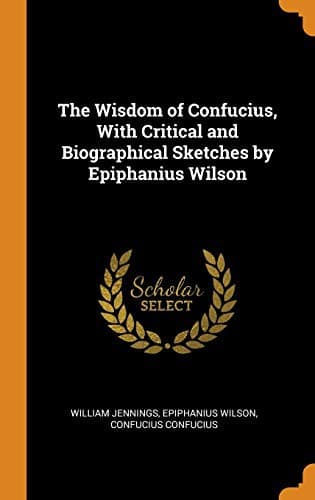
The Wisdom of Confucius: with Critical and Biographical SketchesConfucius
ReligionEastern
The Wisdom of Confucius: with Critical and Biographical Sketches
Confucius
Ethics -- China; Philosophy, Chinese
The answer here was, "Omitting to instruct the people and then
inflicting capital punishment on them--which means cruel tyranny.
Omitting to give them warning and yet looking for perfection in
them--which means oppression. Being slow and late in issuing
requisitions, and exacting strict punctuality in the returns--which
means robbery. And likewise, in intercourse with men, to expend and to
receive in a stingy manner--which is to act the part of a mere
commissioner."
"None can be a superior man," said the Master, "who does not recognize
the decrees of Heaven.
"None can have stability in him without a knowledge of the proprieties.
"None can know a man without knowing his utterances."
THE SAYINGS OF MENCIUS
[_Translated into English by James Legge_]
INTRODUCTION
A hundred years after the time of Confucius the Chinese nation seemed
to have fallen back into their original condition of lawlessness and
oppression. The King's power and authority was laughed to scorn, the
people were pillaged by the feudal nobility, and famine reigned in
many districts. The foundations of truth and social order seemed to be
overthrown. There were teachers of immorality abroad, who published
the old Epicurean doctrine, "Let us eat and drink, for to-morrow we
die." This teaching was accompanied by a spirit of cold-blooded
egotism which extinguished every spark of Confucian altruism. Even the
pretended disciples of Confucius confused the precepts of the Master,
and by stripping them of their narrow significance rendered them
nugatory. It was at this point that Mang-tsze, "Mang the philosopher,"
arose. He was sturdy in bodily frame, vigorous in mind, profound in
political sagacity and utterly fearless in denouncing the errors of
his countrymen. He had been brought up among the disciples of
Confucius, in whose province he was born B.C. 372, but he was much
more active and aggressive, less a Mystic than a fanatic, in
comparison with his Master. He resolved on active measures in stemming
the tendency of his day. He did indeed surround himself with a school
of disciples, but instead of making a series of desultory travels,
teaching in remote places and along the high-road, he went to the
heart of the evil. He presented himself like a second John the Baptist
at the courts of kings and princes, and there boldly denounced vice
and misrule. It was not difficult for a Chinese scholar and teacher to
find access to the highest of the land. The Chinese believed in the
divine right of learning, just as they believed in the divine right of
kings. Mang employed every weapon of persuasion in trying to combat
heresy and oppression; alternately ridiculing and reproving: now
appealing in a burst of moral enthusiasm, and now denouncing in terms
of cutting sarcasm the abuses which after all he failed to check. The
last prince whom he successfully confronted was the Marquis of Lu, who
turned him carelessly away. He accepted this as the Divine sentence of
Public-domain text, read in full here on John Shaqi.
Reviews
Reviews
No reviews yet
Be the first to share your thoughts on this work.
Elsewhere in the archive
Join the Discussion
Join the discussion
Sign in to leave a comment or review.
Sign InorCreate an account