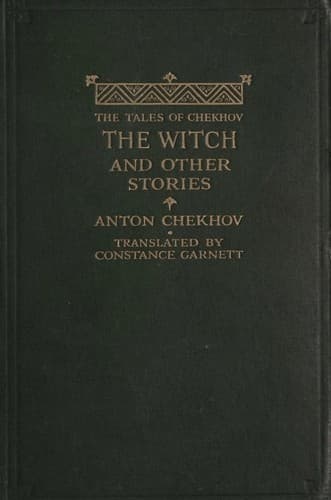
The Witch, and Other StoriesChekhov, Anton Pavlovich
General
The Witch, and Other Stories
Chekhov, Anton Pavlovich
Chekhov, Anton Pavlovich, 1860-1904 -- Translations into English; Russia -- Social life and customs -- Fiction; Short stories
“Yes,” he said, “your elbow is near, but you can’t bite it. There is
fortune, but there is not the wit to find it.”
And he turned facing the shepherds. His stern face looked sad and
mocking, as though he were a disappointed man.
“Yes, so one dies without knowing what happiness is like...” he said
emphatically, lifting his left leg into the stirrup. “A younger man may
live to see it, but it is time for us to lay aside all thought of it.”
Stroking his long moustaches covered with dew, he seated himself heavily
on the horse and screwed up his eyes, looking into the distance, as
though he had forgotten something or left something unsaid. In the
bluish distance where the furthest visible hillock melted into the mist
nothing was stirring; the ancient barrows, once watch-mounds and tombs,
which rose here and there above the horizon and the boundless steppe had
a sullen and death-like look; there was a feeling of endless time and
utter indifference to man in their immobility and silence; another
thousand years would pass, myriads of men would die, while they would
still stand as they had stood, with no regret for the dead nor interest
in the living, and no soul would ever know why they stood there, and
what secret of the steppes was hidden under them.
The rooks awakening, flew one after another in silence over the earth.
No meaning was to be seen in the languid flight of those long-lived
birds, nor in the morning which is repeated punctually every twenty-four
hours, nor in the boundless expanse of the steppe.
The overseer smiled and said:
“What space, Lord have mercy upon us! You would have a hunt to find
treasure in it! Here,” he went on, dropping his voice and making a
serious face, “here there are two treasures buried for a certainty.
The gentry don’t know of them, but the old peasants, particularly
the soldiers, know all about them. Here, somewhere on that ridge [the
overseer pointed with his whip] robbers one time attacked a caravan of
gold; the gold was being taken from Petersburg to the Emperor Peter who
was building a fleet at the time at Voronezh. The robbers killed the
men with the caravan and buried the gold, but did not find it again
afterwards. Another treasure was buried by our Cossacks of the Don.
In the year ‘12 they carried off lots of plunder of all sorts from the
French, goods and gold and silver. When they were going homewards they
heard on the way that the government wanted to take away all the gold
and silver from them. Rather than give up their plunder like that to the
government for nothing, the brave fellows took and buried it, so that
their children, anyway, might get it; but where they buried it no one
knows.”
“I have heard of those treasures,” the old man muttered grimly.
“Yes...” Panteley pondered again. “So it is....”
Public-domain text, read in full here on John Shaqi.
Reviews
Reviews
No reviews yet
Be the first to share your thoughts on this work.
Elsewhere in the archive
Join the Discussion
Join the discussion
Sign in to leave a comment or review.
Sign InorCreate an account