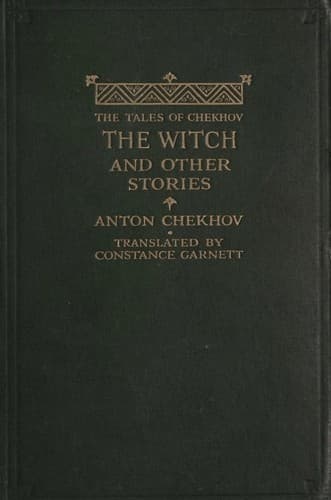
The Witch, and Other StoriesChekhov, Anton Pavlovich
General
The Witch, and Other Stories
Chekhov, Anton Pavlovich
Chekhov, Anton Pavlovich, 1860-1904 -- Translations into English; Russia -- Social life and customs -- Fiction; Short stories
Sitting on the edge of the slope, Nikolay and Olga watched the sun
setting, watched the gold and crimson sky reflected in the river, in
the church windows, and in the whole air--which was soft and still and
unutterably pure as it never was in Moscow. And when the sun had set the
flocks and herds passed, bleating and lowing; geese flew across from
the further side of the river, and all sank into silence; the soft light
died away in the air, and the dusk of evening began quickly moving down
upon them.
Meanwhile Nikolay’s father and mother, two gaunt, bent, toothless
old people, just of the same height, came back. The women--the
sisters-in-law Marya and Fyokla--who had been working on the landowner’s
estate beyond the river, arrived home, too. Marya, the wife of Nikolay’s
brother Kiryak, had six children, and Fyokla, the wife of Nikolay’s
brother Denis--who had gone for a soldier--had two; and when Nikolay,
going into the hut, saw all the family, all those bodies big and little
moving about on the lockers, in the hanging cradles and in all the
corners, and when he saw the greed with which the old father and the
women ate the black bread, dipping it in water, he realized he had made
a mistake in coming here, sick, penniless, and with a family, too--a
great mistake!
“And where is Kiryak?” he asked after they had exchanged greetings.
“He is in service at the merchant’s,” answered his father; “a keeper in
the woods. He is not a bad peasant, but too fond of his glass.”
“He is no great help!” said the old woman tearfully. “Our men are a
grievous lot; they bring nothing into the house, but take plenty out.
Kiryak drinks, and so does the old man; it is no use hiding a sin; he
knows his way to the tavern. The Heavenly Mother is wroth.”
In honour of the visitors they brought out the samovar. The tea smelt
of fish; the sugar was grey and looked as though it had been nibbled;
cockroaches ran to and fro over the bread and among the crockery. It
was disgusting to drink, and the conversation was disgusting, too--about
nothing but poverty and illnesses. But before they had time to empty
their first cups there came a loud, prolonged, drunken shout from the
yard:
“Ma-arya!”
“It looks as though Kiryak were coming,” said the old man. “Speak of the
devil.”
All were hushed. And again, soon afterwards, the same shout, coarse and
drawn-out as though it came out of the earth:
“Ma-arya!”
Marya, the elder sister-in-law, turned pale and huddled against the
stove, and it was strange to see the look of terror on the face of the
strong, broad-shouldered, ugly woman. Her daughter, the child who had
been sitting on the stove and looked so apathetic, suddenly broke into
loud weeping.
“What are you howling for, you plague?” Fyokla, a handsome woman, also
strong and broad-shouldered, shouted to her. “He won’t kill you, no
fear!”
Public-domain text, read in full here on John Shaqi.
Reviews
Reviews
No reviews yet
Be the first to share your thoughts on this work.
Elsewhere in the archive
Join the Discussion
Join the discussion
Sign in to leave a comment or review.
Sign InorCreate an account