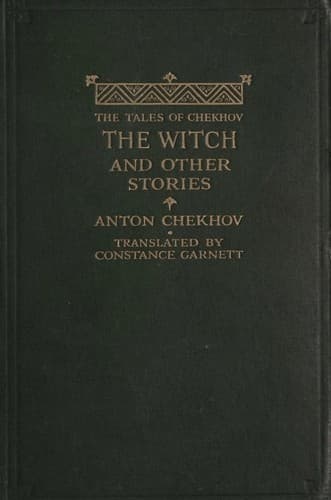
The Witch, and Other StoriesChekhov, Anton Pavlovich
General
The Witch, and Other Stories
Chekhov, Anton Pavlovich
Chekhov, Anton Pavlovich, 1860-1904 -- Translations into English; Russia -- Social life and customs -- Fiction; Short stories
As soon as it dried up and grew warm they got ready to set off. Olga and
Sasha, with wallets on their backs and shoes of plaited bark on their
feet, came out before daybreak: Marya came out, too, to see them on
their way. Kiryak was not well, and was kept at home for another week.
For the last time Olga prayed at the church and thought of her husband,
and though she did not shed tears, her face puckered up and looked
ugly like an old woman’s. During the winter she had grown thinner and
plainer, and her hair had gone a little grey, and instead of the old
look of sweetness and the pleasant smile on her face, she had the
resigned, mournful expression left by the sorrows she had been through,
and there was something blank and irresponsive in her eyes, as though
she did not hear what was said. She was sorry to part from the village
and the peasants. She remembered how they had carried out Nikolay, and
how a requiem had been ordered for him at almost every hut, and all had
shed tears in sympathy with her grief. In the course of the summer and
the winter there had been hours and days when it seemed as though these
people lived worse than the beasts, and to live with them was terrible;
they were coarse, dishonest, filthy, and drunken; they did not live in
harmony, but quarrelled continually, because they distrusted and feared
and did not respect one another. Who keeps the tavern and makes the
people drunken? A peasant. Who wastes and spends on drink the funds of
the commune, of the schools, of the church? A peasant. Who stole from
his neighbours, set fire to their property, gave false witness at the
court for a bottle of vodka? At the meetings of the Zemstvo and other
local bodies, who was the first to fall foul of the peasants? A peasant.
Yes, to live with them was terrible; but yet, they were human beings,
they suffered and wept like human beings, and there was nothing in their
lives for which one could not find excuse. Hard labour that made the
whole body ache at night, the cruel winters, the scanty harvests, the
overcrowding; and they had no help and none to whom they could look for
help. Those of them who were a little stronger and better off could be
no help, as they were themselves coarse, dishonest, drunken, and abused
one another just as revoltingly; the paltriest little clerk or official
treated the peasants as though they were tramps, and addressed even the
village elders and church wardens as inferiors, and considered they had
a right to do so. And, indeed, can any sort of help or good example be
given by mercenary, greedy, depraved, and idle persons who only visit
the village in order to insult, to despoil, and to terrorize? Olga
remembered the pitiful, humiliated look of the old people when in the
winter Kiryak had been taken to be flogged.... And now she felt sorry
for all these people, painfully so, and as she walked on she kept
looking back at the huts.
Public-domain text, read in full here on John Shaqi.
Reviews
Reviews
No reviews yet
Be the first to share your thoughts on this work.
Elsewhere in the archive
Join the Discussion
Join the discussion
Sign in to leave a comment or review.
Sign InorCreate an account