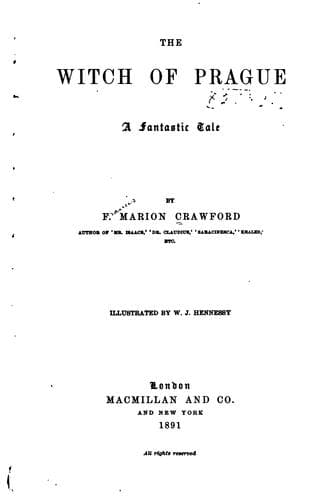
[*] The deeds here described were done in Prague on the
twenty-first day of February in the year 1694. Lazarus and
his accomplice Levi Kurtzhandel, or Brevimanus, or “the
short-handed,” were betrayed by their own people. Lazarus
hanged himself in prison, and Levi suffered death by the
wheel--repentant, it is said, and himself baptized. A full
account of the trial, written in Latin, was printed, and a
copy of it may be seen in the State Museum in Prague. The
body of Simon Abeles was exhumed and rests in the Teyn
Kirche, in the chapel on the left of the high altar. The
slight extension of certain scenes not fully described in
the Latin volume will be pardoned in a work of fiction.
Unorna’s voice sank from the tone of anger to a lower pitch. She spoke
quietly and very distinctly as though to impress every word upon the ear
of the man who was in her power. The Wanderer listened, too, scarcely
comprehending at first, but slowly yielding to the influence she exerted
until the vision rose before him also with all its moving scenes, in all
its truth and in all its horror. As in a dream the deeds that had been
passed before him, the desolate burial-ground was peopled with forms
and faces of other days, the gravestones rose from the earth and piled
themselves into gloomy houses and remote courts and dim streets and
venerable churches, the dry and twisted trees shrank down, and broadened
and swung their branches as arms, and drew up their roots out of the
ground as feet under them and moved hither and thither. And the knots
and bosses and gnarls upon them became faces, dark, eagle-like and
keen, and the creaking and crackling of the boughs and twigs under the
piercing blast that swept by, became articulate and like the voices of
old men talking angrily together. There were sudden changes from day to
night and from night to day. In dark chambers crouching men took counsel
of blood together under the feeble rays of a flickering lamp. In the
uncertain twilight of winter, muffled figures lurked at the corner of
streets, waiting for some one to pass, who must not escape them. As the
Wanderer gazed and listened, Israel Kafka was transformed. He no longer
stood with outstretched arms, his back against a crumbling slab, his
filmy eyes fixed on Unorna’s face. He grew younger; his features were
those of a boy of scarcely thirteen years, pale, earnest and brightened
by a soft light which followed him hither and thither, and he was not
alone. He moved with others through the old familiar streets of
the city, clothed in a fashion of other times, speaking in accents
comprehensible but unlike the speech of to-day, acting in a dim and
far-off life that had once been.
Public-domain text, read in full here on John Shaqi.
Reviews
Reviews
No reviews yet
Be the first to share your thoughts on this work.
Elsewhere in the archive
Join the Discussion
Join the discussion
Sign in to leave a comment or review.
Sign InorCreate an account