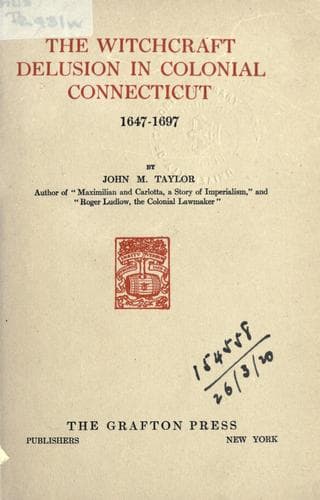
The Witchcraft Delusion in Colonial Connecticut (1647-1697)Taylor, John M. (John Metcalf)
History
The Witchcraft Delusion in Colonial Connecticut (1647-1697)
Taylor, John M. (John Metcalf)
Connecticut -- History -- Colonial period, ca. 1600-1775; Witchcraft -- Connecticut -- History
"She brought diuers psons to the court that they might say something to
cleere her, and much time was spent in hearing ym, but to little
purpose, the grounds of suspition remaining full as strong as before and
she found full of lying, wherfore the court declared vnto her that
though the euidenc is not sufficient as yet to take away her life, yet
the suspitions are cleere and many, wch she cannot by all the meanes she
hath vsed, free herselfe from, therfore she must forbeare from goeing
from house to house to give offenc, and cary it orderly in the family
where she is, wch if she doe not, she will cause the court to comitt her
to prison againe, & that she doe now presently vpon her freedom giue
securitie for her good behauiour; and she did now before the court
ingage fifty pound of her estate that is in Mr. Goodyeers hand, for her
good behauior, wch is further to be cleered next court, when Mr.
Goodyeare is at home."
"She was suffered to dwell in the family of Thomas Johnson, where she
continued till her death, October 9th, 1660." (_New Haven Town Records_,
Vol. ii, pp. 174,179.)
NATHANIEL AND REBECCA GREENSMITH
Nathaniel Greensmith lived in Hartford, south of the little river, in
1661-62, on a lot of about twenty acres, with a house and barn. He also
had other holdings "neer Podunk," and "on ye highway leading to
Farmington."
He was thrifty by divergent and economical methods, since he is credited
in the records of the time with stealing a bushel and a half of wheat,
of stealing a hoe, and of lying to the court, and of battery.
In one way or another he accumulated quite a property for those days,
since the inventory of it filed in the Hartford Probate Office, January
25, 1662, after his execution, carried an appraisal of £137. l4s.
1_d_.--including "2 bibles," "a sword," "a resthead," and a "drachm
cup"--all indicating that Nathaniel judiciously mingled his theology and
patriotism, his recreation and refreshment, with his everyday practical
affairs and opportunities.
But he made one adventure that was most unprofitable. In an evil hour he
took to wife Rebecca, relict of Abraham Elson, and also relict of Jarvis
Mudge, and of whom so good a man as the Rev. John Whiting, minister of
the First Church in Hartford--afterward first pastor of the Second
Church--said that she was "a lewd, ignorant and considerably aged
woman."
This triple combination of personal qualities soon elicited the
criticism and animosity of the community, and Nathaniel and Rebecca fell
under the most fatal of all suspicions of that day, that of being
possessed by the evil one.
Gossip and rumor about these unpopular neighbors culminated in a formal
complaint, and December 30, 1662, at a court held at Hartford, both the
Greensmiths were separately indicted in the same formal charge.
Public-domain text, read in full here on John Shaqi.
Reviews
Reviews
No reviews yet
Be the first to share your thoughts on this work.
Elsewhere in the archive
Join the Discussion
Join the discussion
Sign in to leave a comment or review.
Sign InorCreate an account