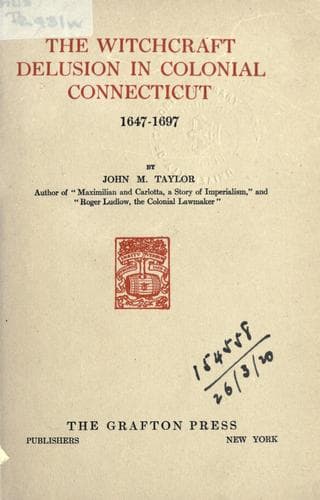
The Witchcraft Delusion in Colonial Connecticut (1647-1697)Taylor, John M. (John Metcalf)
History
The Witchcraft Delusion in Colonial Connecticut (1647-1697)
Taylor, John M. (John Metcalf)
Connecticut -- History -- Colonial period, ca. 1600-1775; Witchcraft -- Connecticut -- History
Staplies' wife was a character. She was "a light woman" from the night
of her memorable ride with Tom Tash, to Jemeaco, Long Island, to the
suspicion of herself as a witch, and the "repairing" of her name by
Thomas' lawsuit, and her own indictment for familiarity with Satan some
years later. That she had many of the traditional witch qualities, and
was something of a gymnast and hypnotist, is written in the vivid
recollections of Tash's experience with her. This was his account of it
on oath thirty years after:
"John Tash aged about sixty four or thareabouts saith he being at Master
Laueridges at Newtown on Long Island aboutt thirty year since Goodman
Owen and Goody Owin desired me to goe with Thomas Stapels wiffe of
Fairfield to Jemeaco on Long Island to the hous of George Woolsy and as
we war going along we cam to a durty slow and thar the hors blundred in
the slow and I mistrusted that she the said Goody Stapels was off the
hors and I was troubiled in my mind very much soe as I cam back I
thought I would tak better noatis how it was and when I cam to the slow
abovesaid I put on the hors prity sharp and then I put my hand behind me
and felt for her and she was not upon the hors and as soon as we war out
of the slow she was on the hors behind me boath going and coming and
when I cam home I told thes words to Master Leveredg that she was a
light woman as I judged and I am redy to give oath to this when leagaly
caled tharunto as witnes my hand.
his "John+Tash mark
"Grenwich July 12, 1692.
"John Tash hath given oath to his testimony abovesaid
"Before me John Renels Comessener."
And Mistress Staplies had other qualities, always potent in small
communities to invite criticism and dislike. She was a shrewd and
shrewish woman, impatient of some of the Puritan social standards and of
the laws of everyday life. She openly condemned certain common
moralities, was reckless in criticism of her neighbors, and quarreled
with Ludlow about some church matters.
It is evident from the testimonies that Staplies was on both sides as to
the guilt of goodwife Knapp, and when rumor and suspicion began to point
to herself as a mischief-maker and busybody in witchcraft matters, to
divert attention from his wife and set a backfire to the sweep of public
opinion, Thomas sued Ludlow, and despite his strong and clear defense as
shown on the record evidence, the court in his absence awarded damages
against him for defamation and for charging Staplies' wife with going on
"in a tract of lying," "in reparation of his wife's name" as the
judgment reads. Mistress Staplies did not grow in grace, or in the
graces of her neighbors, since some years later she was indicted for
witchcraft, tried, and acquitted with others, at Fairfield, in 1692.[J]
[Footnote J: See _Historical Note_, p. 161.]
CHAPTER XI
Public-domain text, read in full here on John Shaqi.
Reviews
Reviews
No reviews yet
Be the first to share your thoughts on this work.
Elsewhere in the archive
Join the Discussion
Join the discussion
Sign in to leave a comment or review.
Sign InorCreate an account