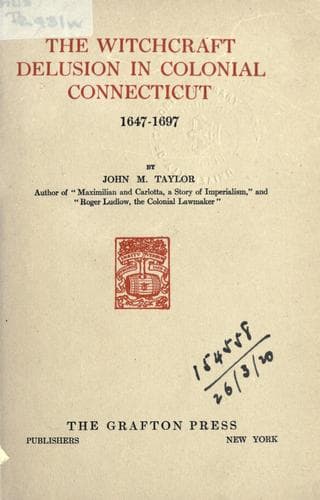
The Witchcraft Delusion in Colonial Connecticut (1647-1697)Taylor, John M. (John Metcalf)
History
The Witchcraft Delusion in Colonial Connecticut (1647-1697)
Taylor, John M. (John Metcalf)
Connecticut -- History -- Colonial period, ca. 1600-1775; Witchcraft -- Connecticut -- History
"Who then was the 'witch' with whose execution Connecticut stepped into
the dark shadow of persecution? She has been called Mary Johnson, but no
Mary Johnson has been identified as this earliest victim. Whose is that
pathetic figure shrinking in the twilight of that early record? We could
think of her with no less kindly compassion could we give a name to the
unhappy victim of the misread Word of God, who was led forth to a death
stripped of dignity as of consolation: who to an ignorance and
credulity, brought from an old world and not yet sifted out by the
enlightenment and experience of a new, yielded up her perhaps miserable
but unforfeited life. Here is the note which in all probability
establishes the identity of the One of Windsor arraigned and executed as
a witch--'May 26, 47 Alse Young was hanged.'" _"One Blank" of Windsor_
(Courant Literary Section, 12, 3, 1904), ANNIE ELIOT TRUMBULL.
Matthew Grant came over with the Dorchester men from the Bay Colony in
1635, and settled in Windsor, Connecticut, where he lived until his
death there in 1683.
He was a land surveyor, and the town clerk, a close observer of men and
their public and private affairs, and kept a careful record of current
events in a "crabbed, eccentric but by no means entirely illegible hand"
during the long years of his sojourn in the "Lord's Waste."
It has been surmised for several years--but without confirmation--and
credited by the highest authorities in Connecticut colonial history, and
known only to one of them, that Grant's manuscript diary contained the
significant historical note as to the fate of Alse Young. It waited two
centuries and more for its true interpreter, as did Wolcott's cipher
notes of Hooker's famous sermon, and there it is, "not made on the
decorous pages which memorize the saints," Brookes, Hooker, Warham,
Reyner, Hanford, and Huit, "but scrawled on the inside of the cover,
where it might be the sinner might escape detection."
In the publication of Grant's note Miss Trumbull has rendered a great
service in the settlement of a disputed question, in the correction of
errors, in fixing the priority of the outbreak between Massachusetts and
Connecticut; and in the new light shining through this revelation stands
Alse, glorified with the qualities of youth, of gentleness, of
innocence; and the story of her going to the unholy sacrifice on that
fateful May morning more than two and a half centuries ago is told with
exquisite tenderness and pathos.
Confirmation of the truth of Grant's entry is given by the scholarly
historian of Windsor, Dr. Stiles, who says in his history of that
ancient town:
"We know that a John Youngs, [?] bought land in Windsor of William
Hubbard in 1641--which he sold in 1649--and thereafter disappears from
record. He may have been the husband or father of 'Achsah'[?] the witch;
if so, it would be most natural that he and his family should leave
Windsor." STILES' _History of Windsor_ (pp. 444-450).
Public-domain text, read in full here on John Shaqi.
Reviews
Reviews
No reviews yet
Be the first to share your thoughts on this work.
Elsewhere in the archive
Join the Discussion
Join the discussion
Sign in to leave a comment or review.
Sign InorCreate an account