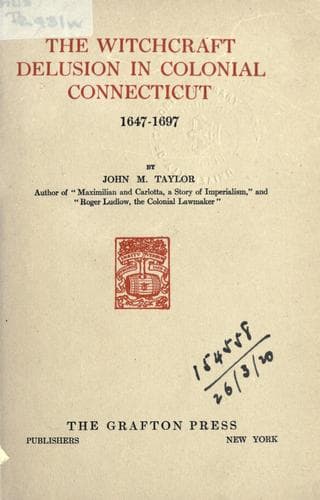
The Witchcraft Delusion in Colonial Connecticut (1647-1697)Taylor, John M. (John Metcalf)
History
The Witchcraft Delusion in Colonial Connecticut (1647-1697)
Taylor, John M. (John Metcalf)
Connecticut -- History -- Colonial period, ca. 1600-1775; Witchcraft -- Connecticut -- History
Desborough was a landowner in Hartford, having received a grant of fifty
acres for his services in the Pequot war. He owes his enrollment in the
hall of fame to Cotton Mather, who was so self-satisfied with his
efforts in "Relating the wonders of the invisible world in preternatural
occurrences" that in his pedantic exuberance he put in a learned
sub-title: "Miranda cano, sed sunt credenda" (The themes I sing are
marvelous, yet true).
Fourteen examples were chosen for the "Thaumatographia Pneumatica," as
"remarkable histories" of molestations from evil spirits, and Mather
said of them, "that no reasonable man in this whole country ever did
question them."
Desborough stands in place as the "fourth example." No case more clearly
illustrates the credulity that neutralized common sense in strong men.
It was a case of abstraction, or theft, or mistaken thrift. A "chest of
cloaths" was missing. The owner, instead of going to law, found his
remedy "in things beyond the course of nature," and he and his friends
with "nimble hands" pelted Desborough's house, and himself when abroad,
with stones, turves, and corncobs, and finally some of his property was
burned by a fire "in an unknown way kindled." Is it not enough to note
that Mather closes this wondrous tale of the spiritual molestations with
the very human explanation that "upon the restoring of the cloaths, the
trouble ceased"?
ELIZABETH CLAWSON. Fairfield, 1692. Acquitted.
Account in previous chapter.
MARY and HANNAH HARVEY. Fairfield, 1692. Jury found no bill.
GOODY MILLER. Fairfield, 1692. Acquitted.
MARY STAPLIES. Fairfield, 1692. Jury found no bill.
Account in previous chapter.
MERCY DISBOROUGH. Fairfield, 1692. Convicted; reprieved. Account in
previous chapter. HUGH CROTIA. Stratford, 1693. Jury found no bill.
Account in previous chapter. _C. & D._ (Vol. I,185).
WINIFRED BENHAM SENIOR and JUNIOR. Wallingford, 1697. Acquitted.
They were mother and daughter (twelve or thirteen years old), tried at
Hartford and acquitted in August, 1697; indicted on new complaints in
October, 1697, but the jury returned on the bill, "Ignoramus." _Records
Court of Assistants_ (1: 74, 77).
SARAH SPENCER. Colchester, 1724. Accused. Damages 1s.
Even a certificate of the minister as to her religion and virtue, could
not free Sarah from a reputation as a witch. And when Elizabeth (and how
many Connecticut witches bore that name) Ackley accused her of "riding
and pinching," and James Ackley, her husband, made threats, Sarah sued
them for a fortune in those days, £500 damages, and got judgment for £5,
with costs. The Ackleys appealed, and at the trial the jury awarded
Sarah damages of ls., and also stated that they found the Ackleys not
insane--a clear demonstration that the mental condition of witchcraft
accusers was taken account of in the later and saner times.
NORTON. Bristol, 1768. Suspicioned. No record.
Public-domain text, read in full here on John Shaqi.
Reviews
Reviews
No reviews yet
Be the first to share your thoughts on this work.
Elsewhere in the archive
Join the Discussion
Join the discussion
Sign in to leave a comment or review.
Sign InorCreate an account