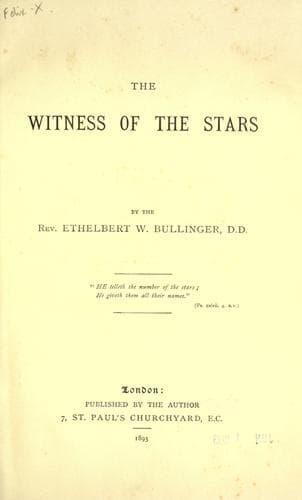
The Witness of the StarsBullinger, E. W. (Ethelbert William)
Religion
The Witness of the Stars
Bullinger, E. W. (Ethelbert William)
Astronomy; Astronomy in the Bible; Bible and science; Constellations
“Keeping,” from שָׁמַר, _to keep_, _observe_, as the heavens. (Ps.
cxxx. 6; Isa. xxi. 11.) Or as the heavenly bodies _observe_ God’s
ordinances.
“Errors,” from שָׁנַה, _to wander_, as the planets.
“Keep back,” חָשַׂךְ, _to hold back_, _restrain_.
“Have dominion over,” from מָשַׁל, _to rule_. Spoken of the sun and
moon in Gen. i. 18. “The sun to rule the day,” &c. (Ps. cxxxvi. 8,
9.)
3 The other half of the Psalm is just as perfectly arranged. For
example, there are six words used (verses 7‐9) to describe the
fulness of the Word of God, and they are thus placed, alternately:—
F | _Two_ feminine singulars. (Law and Testimony.)
G | _One_ masculine plural. (Statutes.)
_F_ | _Two_ feminine singulars. (Commandment and Fear.)
_G_ | _One_ masculine plural. (Judgments.)
4 From סָפֹר, _to cut into_, or _grave_, hence, _to write_. It has the
two senses of our English verb _tell_, which means _to count_, and
also _to narrate_. The first occurrence is Gen. xv. 5, “_Tell_
(סְפֹר) the stars, if thou be able to _number_ (לסֵפֹּר) them.” Gen.
xxiv. 66, “The servant _told_ Isaac all things that he had done.”
Ps. lxxi. 15, “My mouth shall _show forth_ (יְסַפֵּר, _tell of_,
R.V.) thy righteousness and thy salvation all the day; for I know
not the _numbers_ (סְפֹרוֹת, _i.e._, _the accounts_) of them,”
_i.e._, all the particulars.
5 From כָּבַד, _to be heavy, weight_, the context determining whether
the weight spoken of is advantageous or not. The first occurrence is
Gen. xii. 10, “The famine was _grievous_ (כָּבֵד) in the land.” The
next, xiii. 2, “Abram was very _rich_ (כָּבֵד).” It is often applied
to persons who are _of weight_ and _importance_, hence, glorious and
honourable. It is used of the _glory_ of the Lord, and of God
Himself, as we use Majesty of a person. See Isa. iii. 8; iv. 2; xi.
10; xliii. 20; Hag. ii. 8; Ex. xvi. 7; xxiv. 17; 1 Sam. iv. 21; Pss.
xxvi. 8 (_honour_); lxiii. 3.
6 From נָגַד, _to set before_, _to set forth_, _to shew_. First
occurrence, Gen. iii. 11, “Who _told_ thee that thou wast naked.”
Ps. xcvii. 6, “The heavens _declare_ His righteousness”; cxi. 6,
“_He hath shewed_ his people the power of his works.”
7 This is the English idiom for the Hebrew “Day to day.” The ל is used
in its sense of _adding_ or superadding to, as in Isa. xxviii. 10,
צַו לָצָו, “precept to precept;” _i.e._, precept after precept, line
after line. Gen. xlvi. 26, “All the souls that came with Jacob”
(לְיַעֲקֹב, to Jacob; _i.e._, in addition to Jacob. So here, “Day to
day;” _i.e._, Day in addition to day, or, as we say, Day after day).
8 From נָבַע, _to tell forth_, akin to נָבַא, _to prophesy_, from root
_to pour forth_. Lit., here, poureth forth discourse. Ps. cxlv. 9,
“abundantly utter.”
Public-domain text, read in full here on John Shaqi.
Reviews
Reviews
No reviews yet
Be the first to share your thoughts on this work.
Elsewhere in the archive
Join the Discussion
Join the discussion
Sign in to leave a comment or review.
Sign InorCreate an account