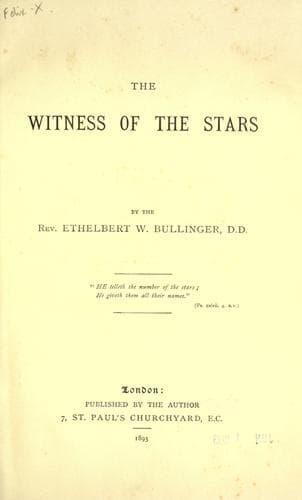
The Witness of the StarsBullinger, E. W. (Ethelbert William)
Religion
The Witness of the Stars
Bullinger, E. W. (Ethelbert William)
Astronomy; Astronomy in the Bible; Bible and science; Constellations
The motions of the sun and moon are so arranged that at the end of a given
interval of time they return into almost precisely the same position, with
regard to each other and to the earth, as they held at the beginning of
that interval. “Almost precisely,” but not quite precisely. There will be
a slight outstanding difference, which will gradually increase in
successive intervals, and finally destroy the possibility of the
combination recurring, or else lead to combinations of a different
character.
Thus the daily difference between the movement of the sun and of the stars
leads the sun back very nearly to conjunction with the same star as it was
twelve months earlier, and gives us the cycle of the year. The slight
difference in the sun’s position relative to the stars at the end of the
year, finally leads the sun back to the same star at the same time of the
year, _viz._, at the spring equinox, and gives us the great precessional
cycle of 25,800 years.
So, too, with eclipses. Since the circumstances of any given eclipse are
reproduced almost exactly 18 years and 11 days later, this period is
called an _Eclipse Cycle_, to which the ancient astronomers gave the name
of _Saros_;(77) and eclipses separated from each other by an exact cycle,
and, therefore, corresponding closely in their conditions, are spoken of
as being one and the same eclipse. Each _Saros_ contains, on the average,
about 70 ± eclipses. Of these, on the average, 42 ± are solar and 28 ± are
lunar. Since the _Saros_ is 11 days (or, more correctly, 10.96 days)
longer than 18 years, the successive recurrences of each eclipse fall 11
days later in the year each time, and in 33 _Sari_ will have travelled on
through the year and come round very nearly to the original date.
But as the _Saros_ does not reproduce the conditions of an eclipse with
absolute exactness, and as the difference increases with every successive
return, a time comes when the return of the _Saros_ fails to bring about
an eclipse at all. If the eclipse be a solar one before this takes place,
a new eclipse begins to form a month later in the year than the old one,
and becomes the first eclipse of a new series.
Public-domain text, read in full here on John Shaqi.
Reviews
Reviews
No reviews yet
Be the first to share your thoughts on this work.
Elsewhere in the archive
Join the Discussion
Join the discussion
Sign in to leave a comment or review.
Sign InorCreate an account