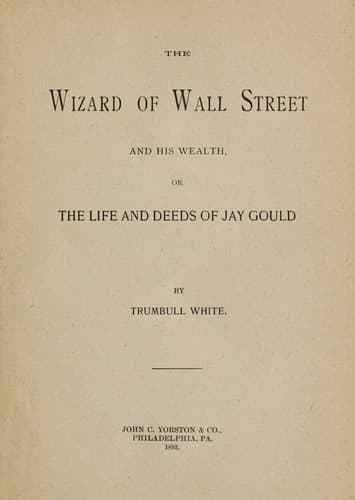
The Wizard of Wall Street and His Wealth; or, The Life and Deeds of Jay GouldWhite, Trumbull
History
The Wizard of Wall Street and His Wealth; or, The Life and Deeds of Jay Gould
White, Trumbull
Businessmen -- United States -- Biography; Capitalists and financiers -- United States -- Biography; Gould, Jay, 1836-1892
The first of the party who arrived at the house to attend the funeral
were three women in deep mourning, an elderly man and two young men.
They came about noon. They were Mr. Gould’s sisters, Mrs. Northrup and
Mrs. Palen, and Mrs. Northrup’s daughter and two sons, and Mr. Abraham
Gould, Mr. Jay Gould’s brother. They came from Philadelphia on an early
train, and went direct to the house. The police vigilance to prevent
the gathering of any crowd was kept up until 1 o’clock, when Capt.
Reilly arrived. He said that people might gather half a dozen deep on
the west side curb and above and below the house on the east side, but
wide passages must be kept open. Sergeant Kelly and Roundsman Bingham
were put on duty on the steps of the Gould house. Dr. Munn talked with
them a few moments in the vestibule. He told them they were to question
everybody and were not to let anybody pass who did not convince them of
his right to enter the house. They were also to keep the steps clear.
Five minutes after Capt. Reilly issued his order to let the little
crowd gather, every inch of space he had allotted to them was taken.
At first it was a crowd composed exclusively of poor people. They were
poorly dressed and many of them looked poorly fed. Curiosity only had
induced them to come. They had not hoped to get into the house. While
this crowd stood in the street there was a hurry and bustle in the
corridor of the Windsor Hotel. The men the poorer people came to see
were forming parties. The directors of the great railroad companies,
the Union Pacific, the Missouri Pacific, and the others, were getting
together. Frank Hain, Julien T. Davies, and Charles A. Gardener,
representing the Manhattan Elevated railroad, were among them. William
C. Whitney had charge of one party.
Once, early in the afternoon, there was what appeared to be a concerted
rush for the steps. A number of persons who were evidently under the
impression that the public was to be admitted at 3 o’clock made a start
at that hour, and two or three hundred others followed. Up they rushed,
and, although the policemen shouted, “Get back! You can’t go in,” a few
did make their way into the house. They were quickly ejected, however,
and thereafter only individual efforts were made to get in. Some of
these were persisted in stubbornly, but without success.
Oddly enough, women pleaded the hardest to be allowed to pass through
the big oak door, women of more than middle age, most of them, who
could give no better reason for wanting to see the face of the dead
railway king than that they “just wanted to see it.” Some declared
that they had come from great distances for that purpose alone. They
went away and returned to beg again. Yet all of them admitted finally
that they had never known Mr. Gould or any of the family. His children
glanced furtively out of the windows at the motley crowd and gave
thanks that the early intention to admit the public had been abandoned.
Public-domain text, read in full here on John Shaqi.
Reviews
Reviews
No reviews yet
Be the first to share your thoughts on this work.
Elsewhere in the archive
Join the Discussion
Join the discussion
Sign in to leave a comment or review.
Sign InorCreate an account