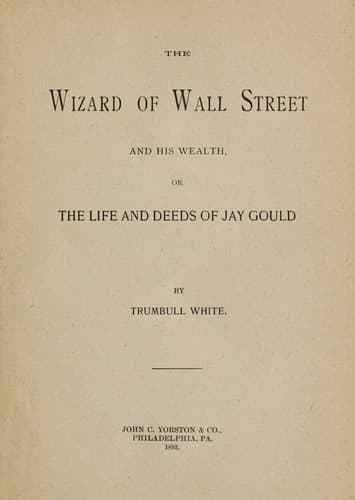
The Wizard of Wall Street and His Wealth; or, The Life and Deeds of Jay GouldWhite, Trumbull
History
The Wizard of Wall Street and His Wealth; or, The Life and Deeds of Jay Gould
White, Trumbull
Businessmen -- United States -- Biography; Capitalists and financiers -- United States -- Biography; Gould, Jay, 1836-1892
None of the Gould family is especially devoted to riding or driving.
George Gould keeps six carriage horses and a saddle horse at his
stable, No. 133 West Fifty-fifth street, but they are more for Mrs.
Gould’s use than his own. His coachman, William Willis, has eight
carriages and light traps to care for. Edwin Gould is a capital rider,
and until his promotion to a captaincy and the post of Inspector of
Rifle Practice in the Seventy-first Regiment, was an active member of
Troop A. He always rode a long-tailed gray thoroughbred, for which he
paid a high price. Edwin Gould was very proficient at wrestling on
horseback, and few of the cavalrymen could unseat him. The Misses Gould
drive daily during their stay at Irvington, using the family carriages
or else handling the reins in the hunting wagon or in a mail phaeton.
[Illustration: George J. Gould]
CHAPTER XVIII.
THE GREAT FORTUNE AND ITS INHERITORS.
Five days after the death of Jay Gould, the contents of his will, or
at least the substance of it, were made public in the press. The will
itself remained under lock and key in the safe of ex-Judge John F.
Dillon, counsel for the executors.
“The original will,” said ex-Judge Dillon, in giving out the summary,
“is dated December 24, 1885, during the lifetime of Mr. Gould’s wife.
It made various provisions for her benefit which failed of effect by
reason of her death before the death of her husband. After and in
consequence of her death, Mr. Gould, on February 16, 1889, executed the
first codicil to his will, making such changes as became necessary. A
second and a third codicil were executed on November 21, 1892.
“Taking the wills and codicils together the summary I give you is
accurate and complete.”
The specific legacies came first. The three sisters, who with their
brother Abraham got $25,000 and an annuity of $2,000, were Mrs. Sarah
Northrup, Mrs. Anna G. Hough and Mrs. Elizabeth Palen. Mrs. Northrup
and her daughters received in addition the three lots of ground in
Camden, N. J., on which their dwelling is erected. The annuities were
to be paid in equal sums quarterly.
To his daughter Helen M. Gould he gave in fee-simple absolute the house
in which he lived, No. 579 Fifth avenue, and all of the furniture,
books, paintings, statuary, silver plate and household contents
therein. He also gave to his daughter Helen, until his youngest child
shall arrive at age, the use of his residence at Irvington, commonly
called Lyndhurst, free of taxes, and of all the furniture, books,
paintings and household contents therein, and also the sum of $6,000
per month. The will stated that this was done in the expectation that
his minor children, Anna and Frank J., as well as his son Howard, would
during the period provided for make their home with his daughter Helen.
Public-domain text, read in full here on John Shaqi.
Reviews
Reviews
No reviews yet
Be the first to share your thoughts on this work.
Elsewhere in the archive
Join the Discussion
Join the discussion
Sign in to leave a comment or review.
Sign InorCreate an account