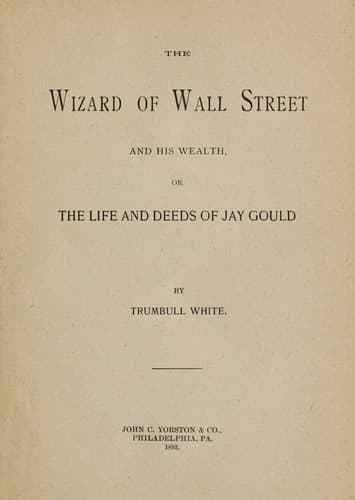
The Wizard of Wall Street and His Wealth; or, The Life and Deeds of Jay GouldWhite, Trumbull
History
The Wizard of Wall Street and His Wealth; or, The Life and Deeds of Jay Gould
White, Trumbull
Businessmen -- United States -- Biography; Capitalists and financiers -- United States -- Biography; Gould, Jay, 1836-1892
In case of difference of opinion among the executors and trustees as to
holding and retaining securities or investments in managing the estate,
he directed that so long as there shall be five executors and trustees
the decision of four should be conclusive, and when four the decision
of three should be conclusive, with this further provision in the
codicil of November 21, 1892:
“The better to protect and conserve the values of my properties, it is
my desire, and I so direct and provide, that the shares of any railway
or other incorporated companies at any time held by my executors and
trustees or my said trustees, shall always be voted by them or by
their proxies at all corporate meetings as a unit; and in case my said
executors and trustees or my said trustees do not concur as to how such
stock shall be voted, then, in view of the fact that my son George J.
Gould has for years had the management of my said properties, and
is familiar with them and with other like properties, I direct and
provide that in such event his judgment shall control, and he is hereby
authorized and empowered to vote the said shares in person or by proxy
in such manner as his judgment shall dictate.”
There was the usual provision that the property of his daughters was
for their sole and separate use, free from any estate or control of
their husbands, and prohibiting all dispositions or changes by any of
the legatees by way of anticipation or otherwise.
There was a provision that if any of his children should marry without
the consent of a majority of the executors and trustees, then the share
allotted to such child should be reduced one-half and the other half
of such share should be transferred to such persons as under the laws
of the state of New York would take the same if the testator had died
intestate.
Who were the witnesses to the Gould will was not divulged by ex-Judge
Dillon; nor was it known who drew the will. Judge Dillon said that he
didn’t. It was thought probable that Gen. Swayne, who was formerly in
partnership with the judge, was the man, but he declined to say. There
were many who believed that Gould himself drew the will. A gentleman
who knew Mr. Gould very well said:
“From what I know of Mr. Gould, however, I believe he drew it himself.
He was naturally a very secretive man, and any important undertaking
he kept to himself as much as possible. He was an able lawyer, and
certainly had sufficient knowledge to have made the will.”
In spite of Mr. Gould’s great interests his executors found his affairs
in very trim shape. Something less than two years ago, in conversation
with Mr. Connor and Mr. Morosini, Mr. Gould remarked:
“If I should die to-night my affairs are in such shape that my
executors could straighten everything out in less than forty-eight
hours after my death.”
Public-domain text, read in full here on John Shaqi.
Reviews
Reviews
No reviews yet
Be the first to share your thoughts on this work.
Elsewhere in the archive
Join the Discussion
Join the discussion
Sign in to leave a comment or review.
Sign InorCreate an account