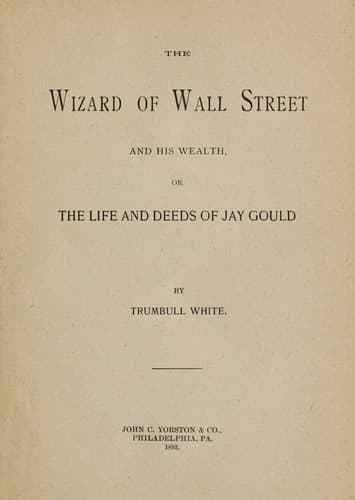
The Wizard of Wall Street and His Wealth; or, The Life and Deeds of Jay GouldWhite, Trumbull
History
The Wizard of Wall Street and His Wealth; or, The Life and Deeds of Jay Gould
White, Trumbull
Businessmen -- United States -- Biography; Capitalists and financiers -- United States -- Biography; Gould, Jay, 1836-1892
Mr. Gould’s name is unidentified with any great public benefactions.
Astor and Tilden founded libraries, Drew established a theological
seminary, George I. Seney distributed millions and Vanderbilt endowed
a hospital, but Gould’s purse was never opened by any such generous
ambition. He was kind to his relatives, gave his brother a good
position in the Missouri Pacific railroad and built his sisters a
school in Camden. He gave liberally to alleviate the suffering by
the Chicago fire and by the Memphis yellow-fever plague, made big
subscriptions to the Grant and Garfield funds, and added eighty acres
to the Mount Vernon property. This was nearly all he did in a public
way. Gould’s politics sprang from his pocket, not from his patriotism.
He has already been quoted as saying that “in Republican districts he
was a Republican, in Democratic districts a Democrat, and in all an
Erie man.” But Mr. Gould was more a Republican than anything else,
for he obtained, or thought he could obtain, more recognition and
protection from that party than from the Democratic. The Republican
party was the party of large land grants, of liberal appropriations
and of corporation tendencies. In presidential elections Mr. Gould
often contributed heavily to the Republican campaign fund, and his
check was always solicited and joyfully received. In 1880 his money
was probably part of that which bought Indiana for the Republicans,
and it was charged that he obtained reward from President Garfield
in the appointment of Stanley Matthews as associate justice of the
Supreme Court, whose views relative to the Pacific railroads and
other corporation questions were understood to be favorable to Gould.
This charge, of course, was hard to prove, and may be unjust to both
Garfield and Matthews.
In 1884 Gould supported Blaine. He was present at the celebrated
millionaire dinner given to Blaine at Delmonico’s two or three
evenings before the election, and which, with the Burchard incident,
probably turned the evenly-balanced scales of public opinion against
the Maine statesman. Gould’s money was powerful and his presence was
contaminating, and the public distrusted any of its servants who seemed
to be friendly with him.
One of the most sensational stories about Mr. Gould’s career is told by
a prominent politician now in Washington.
Public-domain text, read in full here on John Shaqi.
Reviews
Reviews
No reviews yet
Be the first to share your thoughts on this work.
Elsewhere in the archive
Join the Discussion
Join the discussion
Sign in to leave a comment or review.
Sign InorCreate an account