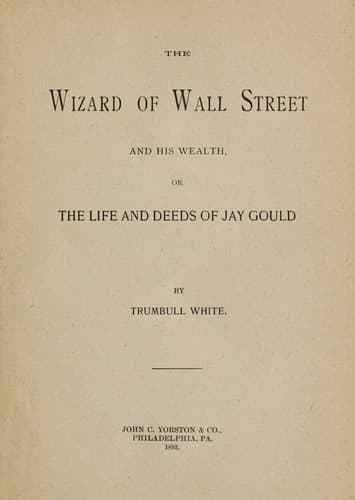
The Wizard of Wall Street and His Wealth; or, The Life and Deeds of Jay GouldWhite, Trumbull
History
The Wizard of Wall Street and His Wealth; or, The Life and Deeds of Jay Gould
White, Trumbull
Businessmen -- United States -- Biography; Capitalists and financiers -- United States -- Biography; Gould, Jay, 1836-1892
He first ran over to Amsterdam from London, arriving there late in the
morning. At 10 A. M. that day he notified the Dutch bondholders of the
Denver Pacific that he would be pleased to meet them at 11 o’clock.
Promptly at that hour he met them, and at 12 he left Amsterdam with
his gripsack full of the securities of the Dutch bondholders. By this
means he captured control of the Denver Pacific. Inside of ten hours
he bought out Commodore Garrison’s interest in the Missouri Pacific.
He bought out ex-Governor Ames’ interest in the Central Branch of the
Union Pacific, and he had previously formed a pool by which he acquired
control of the Kansas Pacific.
One day the Union Pacific directors awoke to the alarming discovery
that Mr. Gould had dropped out of their organization and was surveying
a line from Denver to Salt Lake City. The Kansas Pacific was utterly
worthless, the Central Branch had not earned any money for years, the
Denver Pacific had been in very bad shape; but when the Union Pacific
directors discovered the extent of Mr. Gould’s combinations they lost
no time in boarding a special car in Boston and rushing over to New
York to see him about it. They went up to Mr. Gould’s house and were
there gathered in by him on the consolidation of the three roads,
all of their stock being exchanged at par and merged into the new
Union Pacific Railway Company as distinguished from the Union Pacific
Railroad Company.
This incident formed one of the subjects of inquiry committed to the
Pacific Railroad Commission in 1887. The members of the commission
appointed by President Cleveland consisted of Gov. Pattison, of
Pennsylvania; E. Ellery Anderson of this city, and David Littler, of
Illinois.
The Union Pacific railroad and the Kansas Pacific railroad companies
had received government subsidies in bonds and lands. The bonds were
received upon the stipulation that the companies would pay at par and
accumulated interest upon their maturity. The first of these bonds will
mature in 1895. An application had been made by the Pacific railroads
to Congress to extend the time of payment, and this commission was
appointed to report upon that matter and incidentally to furnish
Congress with information relative to these deals which had affected
the status of the corporations.
Public-domain text, read in full here on John Shaqi.
Reviews
Reviews
No reviews yet
Be the first to share your thoughts on this work.
Elsewhere in the archive
Join the Discussion
Join the discussion
Sign in to leave a comment or review.
Sign InorCreate an account