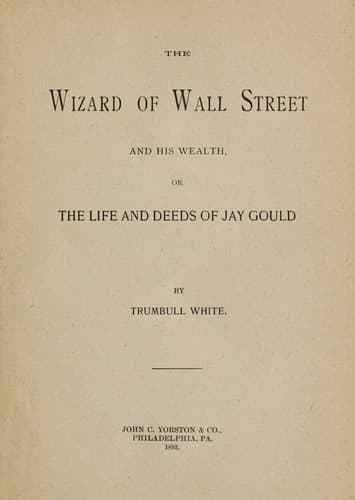
The Wizard of Wall Street and His Wealth; or, The Life and Deeds of Jay GouldWhite, Trumbull
History
The Wizard of Wall Street and His Wealth; or, The Life and Deeds of Jay Gould
White, Trumbull
Businessmen -- United States -- Biography; Capitalists and financiers -- United States -- Biography; Gould, Jay, 1836-1892
The late Charles F. Woerishoffer, Henry N. Smith, and other operators
were united in a combined effort to bear the securities which Gould was
carrying. He had supported them for a time by obtaining sterling bills,
giving his securities as collateral and then converting the bills into
cash. But sterling loans, like all others, come to maturity; the bears
were as unscrupulous as himself, bold and skillful and persistent.
Gould’s Western Union fell to 49 and his Missouri Pacific to 62. He
was beaten. One morning he had his lawyers execute an assignment
of his property, and on the following day--a beautiful Sunday
morning--his yacht went down to Long Branch, where the bear operators
were summering. Gould’s emissaries landed and held a conference with
his foes. They bore his ultimatum--a copy of the assignment and the
statement that unless the bears made terms with him he would on the
following morning file the assignment and give public notice that he
was unable to meet his engagements.
At that time he was supposed to be borrowing some $20,000,000, and
his failure would create a bigger panic than the one the street had
just passed through. Many of the firms with which the bear combine
had “short” contracts outstanding would doubtless fail, and in the
general crash the successful bears themselves might be heavy losers.
After a protracted conference the bears agreed to “let up” on Gould on
condition that he should turn over to them 50,000 shares of Western
Union at the current market price, $50 per share. This enabled them to
make delivery of the shares they had sold at high prices. In speaking
of this “deal” the following day, one of the bears expressed his
confidence that Gould would have to fail anyhow--the help he received
would be transient in its effect as a glass of brandy given to a dying
man.
He was wrong. He underestimated the fertility of resource in Gould and
his associates.
Many of the men in the financial quarter of New York City the day
of his death devoted their time to forming estimates of Mr. Gould’s
character as a man and relating anecdotes of his life. In reference to
the general subject under discussion, Col. Henry T. Chapman, the art
connoisseur of the Stock Exchange, said:
“Gould’s art collection was little known, for he rarely ever figured
personally in buying pictures, and went so little into social life
that the public had no knowledge of his gallery. It is very choice,
however, consisting of about one hundred paintings. Many of them are
representative works of the Barbizon and modern French school. He has
one of the finest examples of Corot in the country, and masterpieces by
Rousseau, De Neufville and others.
Public-domain text, read in full here on John Shaqi.
Reviews
Reviews
No reviews yet
Be the first to share your thoughts on this work.
Elsewhere in the archive
Join the Discussion
Join the discussion
Sign in to leave a comment or review.
Sign InorCreate an account