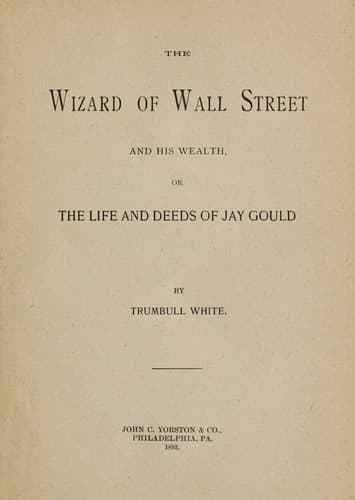
The Wizard of Wall Street and His Wealth; or, The Life and Deeds of Jay GouldWhite, Trumbull
History
The Wizard of Wall Street and His Wealth; or, The Life and Deeds of Jay Gould
White, Trumbull
Businessmen -- United States -- Biography; Capitalists and financiers -- United States -- Biography; Gould, Jay, 1836-1892
“I then went into the Union Pacific road. I met Horace Clark and
Augustus Schell out West, and they gave me so good an account of the
road that I concluded I would buy in it. I telegraphed to New York
an order to buy at a certain price. When Mr. Clark got home he was
taken ill, and as soon as his brokers learned that his illness was to
be fatal, they sold out his stock. That broke the market and filled
orders which I had sent at a price lower than I ever expected. When I
got home I found myself the owner of a large amount of this property,
and at once inquired into its condition. I learned that it was saddled
with a large floating debt, and that there were ten million dollars of
bonds coming due within a month. It was in rather a blue condition.
The directors were consulting who should be the receiver. I made up my
mind that I would carry it through, and I told them that if they would
furnish half of the money to pay the debt, I would furnish the other
half. The stock went down to 15. It was a large loss, but still I kept
right on buying, so when the turn came there did not seem to be any top
to it. It went up to 75, and I immediately went to work to bring the
road up. I went out over it, started coal mines, and to the surprise
of everybody it soon began to pay dividends and has never passed a
dividend since.
“Well,” continued Mr. Gould, “when this road began to be a financial
success and developed other ways there arose quite a clamor, and it
was said to be Jay Gould’s road, as though it were a dangerous thing
to have one man control a road. I thought that it was better to bow to
public opinion, so I took the opportunity when I could to place the
stock in the hands of investors. In the course of a very few months,
instead of owning control of the road I was entirely out of it, and
the stock was 20 per cent. higher than I had sold it for. Instead of
being thirty or forty stockholders, there were between six and seven
thousand, representing the savings of widows and orphans. There were
also a great many lady stockholders. That was about four years ago,
after Congress enacted very harsh legislation, after they had broken
the bargain they had made to get the road through in its early stages.”
“You refer to the Thurman act?” asked the chairman.
“Yes, and that closed my connection with the Union Pacific road.”
This is a very beautiful picture and it makes out Mr. Gould to be a
most public-spirited and generous man--one ready to sacrifice his own
interests in obedience to the demand of public opinion. But, having
looked on this picture, look upon that drawn by the Pacific Railroad
Commission, appointed by President Cleveland in 1887, and composed of
ex-Gov. Pattison, of Pennsylvania; E. Ellery Anderson, of New York, and
David Littler, of Illinois. The commission made two reports, agreeing
substantially, only that of ex-Gov. Pattison was more severe in its
conclusions.
Public-domain text, read in full here on John Shaqi.
Reviews
Reviews
No reviews yet
Be the first to share your thoughts on this work.
Elsewhere in the archive
Join the Discussion
Join the discussion
Sign in to leave a comment or review.
Sign InorCreate an account