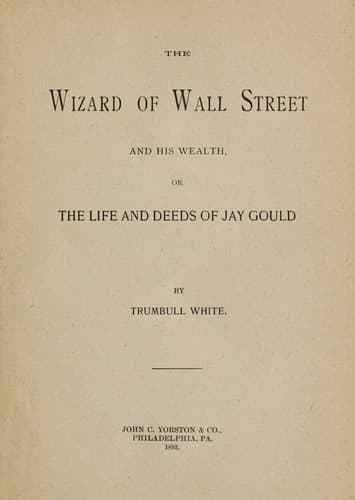
The Wizard of Wall Street and His Wealth; or, The Life and Deeds of Jay GouldWhite, Trumbull
History
The Wizard of Wall Street and His Wealth; or, The Life and Deeds of Jay Gould
White, Trumbull
Businessmen -- United States -- Biography; Capitalists and financiers -- United States -- Biography; Gould, Jay, 1836-1892
In the majority report, by Messrs. Anderson and Littler, the purchase
of a controlling interest by Jay Gould in 1873, the subsequent increase
in the capital stock to 200,000 shares, the inauguration of the policy
of constructing branch lines in 1877 and the commencement of the
action by the United States against the directors of the Union Pacific
for misappropriating the assets of the company were detailed and the
report went on to say: “It appears from the minutes of the company that
while this litigation was pending certain proceedings were taken by
the directors, whereby by their own acts and votes they undertook to
release themselves from any obligations or liabilities to the company.”
The Kansas Pacific’s financial operations from 1864 to 1880 were also
taken up and the circumstances leading up to its consolidation in the
Union Pacific system were detailed at great length. The acquisition
by Jay Gould in 1877, at nominal figures, of several millions of
securities of the Kansas Pacific was spoken of, and the reorganization
of that company under the control of Gould was detailed and the methods
severely condemned. The effect of the consolidation was to increase the
stock of the Union Pacific from $38,000,000 to $50,000,000, and the
bonded indebtedness from $88,000,000 to $126,000,000, and the other
indebtedness from $4,000,000 to nearly $10,000,000. It was declared
that “the three years following the consolidation were years of great
business activity, and the receipts of the Union Pacific for 1880,
1881, 1882 and 1883 were largely increased,” but “in the face of a very
large and apparently profitable business” the company found itself
early in 1884 on the verge of bankruptcy.” Competition, the burden
of its fixed charges, the extravagant sums paid for branch railroads
of little or no earning power bought by Mr. Gould, and the “lavish
and reckless distribution of the assets of the company in dividends,
all combined to produce this result.” After stating that Gould’s
connection with the road ceased in 1883, the report says: “It is with
a sense of great relief that the commission turns from the history of
this company from 1873 to 1883 [the period of Gould’s control--Ed.]
to the conservative, energetic and intelligent management that has
characterized the management from the opening of 1884 to the present
time.”
Ex-Gov. Pattison, in his report, said:
Public-domain text, read in full here on John Shaqi.
Reviews
Reviews
No reviews yet
Be the first to share your thoughts on this work.
Elsewhere in the archive
Join the Discussion
Join the discussion
Sign in to leave a comment or review.
Sign InorCreate an account