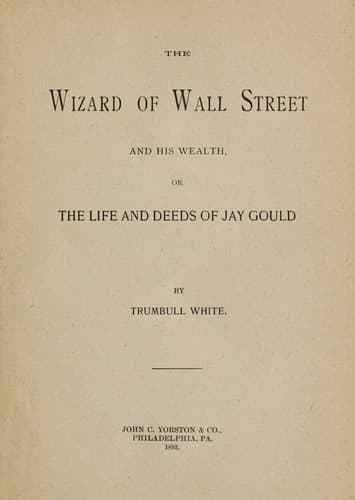
The Wizard of Wall Street and His Wealth; or, The Life and Deeds of Jay GouldWhite, Trumbull
History
The Wizard of Wall Street and His Wealth; or, The Life and Deeds of Jay Gould
White, Trumbull
Businessmen -- United States -- Biography; Capitalists and financiers -- United States -- Biography; Gould, Jay, 1836-1892
Mr. Gould’s Southwestern system, of which he speaks in terms so
glowing, was composed of the Missouri Pacific, that was the main
stem, and grafted onto it was the Wabash, of which an account has
already been given; the Missouri, Kansas and Texas; the St. Louis and
Iron Mountain, and the Texas Pacific. The directors of all the roads
were substantially the same, Mr. Gould being the president, and his
son George, Russell Sage, A. L. Hopkins and others of his intimate
associates being the directors. The most striking feature about the
management of these roads is that while all the others were driven
into bankruptcy, or to the verge of it, the Missouri Pacific was made
a big dividend-paying property. Mr. Gould attributed this to the
comparatively small indebtedness of the Missouri Pacific, making
it, in his own language, “the snuggest property on the continent;”
but his enemies attributed the fact to another reason, namely, Mr.
Gould’s own management, by which he was alleged to have starved the
other properties to feed the Missouri Pacific. His holdings of the
latter’s stock were immense, while his pecuniary interest in the others
was comparatively small; indeed, he held but a few hundred shares of
Missouri, Kansas and Texas, though its president. His purpose was
evidently to swell the earnings of the Missouri Pacific to such an
extent that he could declare big dividends and sell his stock at high
figures. He succeeded in pushing the price up to 112 in May, 1887,
but it subsequently fell to 70¼ in March, 1888. The lack of public
confidence in Gould’s railroad methods is strikingly exhibited in
the fact that though Missouri Pacific paid 6 to 7 per cent. annual
dividends, Gould found it almost impossible to keep the price at par
except by the pegging process, while other equal dividend-payers
brought from 110 to 130 in the market without manipulation. The same
fact was also strikingly exhibited in Western Union, which paid
dividends, but sold at from 70 to 80.
Finally the stockholders of the Missouri, Kansas and Texas became
indignant at the destruction of their property. Much of the stock
was held abroad and was only worth $13 to $15 per share of $100.
They engaged E. Ellery Anderson, the same who had been a member of
the Pacific Railroad Commission, and Simon Sterne, who had been
the counsel for the Hepburn Committee, to represent them, and in
connection with such Wall street men as W. L. Bull, shortly after
elected president of the Stock Exchange, they hurled the Gould
management from power. They publicly charged Mr. Gould with having
used the road simply as a feeder to the Missouri Pacific. Mr. Gould
succeeded, at least in part, with his plans in regard to Missouri
Pacific, and is understood to have marketed a large block of his
holdings in 1888. Shortly after that the road reduced its dividend and
had to borrow money to pay it.
Public-domain text, read in full here on John Shaqi.
Reviews
Reviews
No reviews yet
Be the first to share your thoughts on this work.
Elsewhere in the archive
Join the Discussion
Join the discussion
Sign in to leave a comment or review.
Sign InorCreate an account