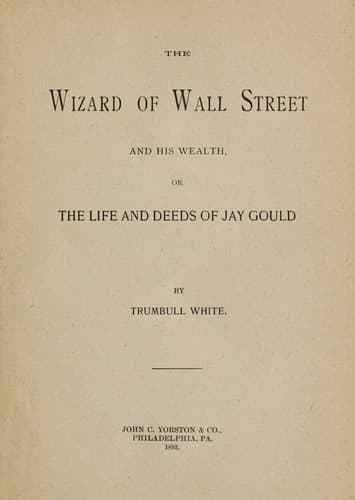
The Wizard of Wall Street and His Wealth; or, The Life and Deeds of Jay GouldWhite, Trumbull
History
The Wizard of Wall Street and His Wealth; or, The Life and Deeds of Jay Gould
White, Trumbull
Businessmen -- United States -- Biography; Capitalists and financiers -- United States -- Biography; Gould, Jay, 1836-1892
But Mr. Connor was not Gould’s only broker. Charles J. Osborn was for
years one of Gould’s closest lieutenants and associates, and a more
dashing broker never stepped into the Stock Exchange. William Heath,
“the antelope of Wall street,” as he was called because of his long
legs and slender body, was also long a favorite with Gould. Heath was
a master at keeping secrets. None of his customers could ever learn
what his other customers were doing. His faithfulness, experience and
ability, however, availed him little in the end. He assisted Gould in
Black Friday and helped him in many a risky transaction. When Heath
failed with Henry N. Smith in 1885, Mr. Gould, though, with Morosini,
the principal creditor, did not come to his assistance. It was thought
that Gould would put him on his feet again, but he did not do so, and
Heath--alone, broken in spirit and in fortune--died shortly after in
Staten Island, but not until he had been lodged for a while in Ludlow
street jail, a prisoner for debt.
On the dissolution of W. E. Conner & Co., Dec. 31, 1885, Mr. Gould
announced his permanent retirement from the street. That perhaps was
his intention (though he was as prolific in retirements as Charlotte
Cushman), but it was not long before his presence was again felt in the
Stock Exchange.
Gould had other personal encounters besides the one with Major Selover.
Once, while lunching in Delmonico’s, a lawyer named Marrin addressed
him and asked him to accompany him to a private room. Mr. Gould
declined. Marrin struck him in the face, saying: “If you have no time
to see me, take that!” Mr. Gould quietly continued his lunch. Mr.
Marrin was summoned before a magistrate and compelled to give $500
bonds.
It was his habit to have duplicated reports from corporation officers
before the originals were presented. He was now and then cheated, but
not often. On one occasion a leading editorial severely animadverting
on him and Fisk was shown to him before any considerable part of the
paper’s edition had gone to press. He handed the party who brought him
the paper $10,000 in greenbacks and the edition appeared without the
disturbing criticism. His enemies were numerous, not that he hated any
one himself, but his operations necessarily involved men of small means
and often ruined them outright.
Congressman John B. Alley is said to have remarked of him at
twenty-four: “I won’t go into anything with that lad. He is the only
person I ever saw who inspires me with fear.” Vanderbilt said, “His
face is a scoundrel’s.” He was often accused of “milking the street,”
“forcing quotations,” “washing,” and “covering his shorts,” but on the
other hand, when he agreed to enter a pool he acted squarely with his
associates unless he caught them at treachery, and then he quietly
waited for an opportunity to pay them off. He was a special partner
in several firms of brokers and carefully concealed from each his
operations with the others.
[Illustration: JAY GOULD’S DEATHBED.]
Public-domain text, read in full here on John Shaqi.
Reviews
Reviews
No reviews yet
Be the first to share your thoughts on this work.
Elsewhere in the archive
Join the Discussion
Join the discussion
Sign in to leave a comment or review.
Sign InorCreate an account