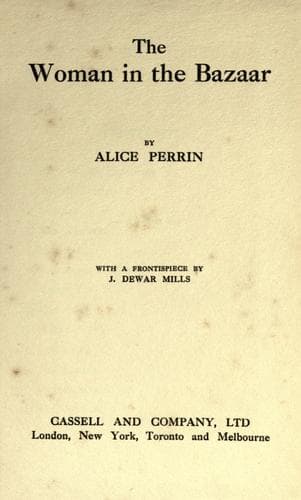
British -- India -- Fiction; India -- Social life and customs -- Fiction
"But you must come across such _interesting_ things in the bazaars!"
said the boy, in a pleading voice. His ambition had been to write, to
become an author, to follow in the footsteps of Stevenson, Kipling, and
other great masters of romance; but his people, being practical, had
scolded and pushed him into the Indian Public Works, and he had no time
to use his pen for anything but estimates, reports, and office work,
which bored his imaginative soul.
"I did come across an odd little echo of the past only the other day,"
the policeman admitted with an effort. "I had breakfast one morning with
some missionaries in an out-of-the-way corner of my district, and I
noticed an old Englishwoman wandering about the compound with an ayah in
attendance. She was dressed in grey, with a poke bonnet and full skirts,
like the pictures in old _Punches_. They told me she had been found at
the time of the Mutiny as a young girl of about fifteen hiding in the
jungle wearing native clothes. Nobody knew who she was, and the poor
thing couldn't tell them because she was out of her mind, and she had
never recovered her reason. She had been handed on to these people by
the missionaries they succeeded, and by others before them--and there
she had been living for over fifty years, perfectly harmless, costing
very little, and only insisting on being dressed in grey and in the
fashion of the Mutiny time. If they tried to put her into anything else
she only cried and protested pitifully, so they just went on copying the
garments, and called her 'Miss Grey.' They can only suppose that her
people were killed in the outbreak, and that some faithful servant
disguised her and hid her in the jungle, and that then she got lost and
went out of her mind with terror."
"And no one will ever know who she was, or what really happened," said
the boy, drawing a long breath. "Unless, perhaps, when she is dying it
may all come back to her?"
"It's to be hoped it won't," said the policeman, who was not a
romanticist.
"It was lucky for 'Miss Grey' that she was found by friends," put in
Markham. "By the way, do you remember that case a few years ago----"
Somnolence stole over Coventry's brain once more; the voices droned on
and grew fainter, floating away into space; his head drooped again, and
he found himself back in the station, not at all disconcerted because,
with the curious inconsequence of dreams, his bungalow and the racquet
court had in some marvellous manner been merged into one. He was playing
an excellent game, though the furniture got in the way and Trixie kept
trying to stop him. She was saying: "George, do come away--think of the
woman in the bazaar"; and a crowd of men standing by shouted in chorus:
"Yes, remember, old chap, the woman in the bazaar." Then he fell over a
chair in the act of making a wonderful stroke, and as, with a jerk, he
awoke, he heard Markham repeating--"woman in the bazaar."
Public-domain text, read in full here on John Shaqi.
Reviews
Reviews
No reviews yet
Be the first to share your thoughts on this work.
Elsewhere in the archive
Join the Discussion
Join the discussion
Sign in to leave a comment or review.
Sign InorCreate an account