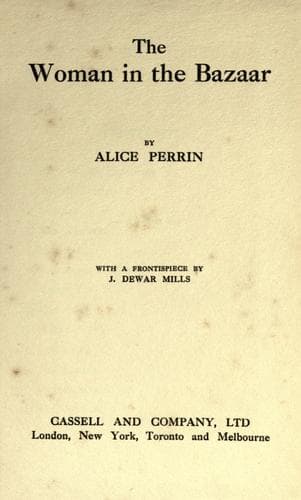
British -- India -- Fiction; India -- Social life and customs -- Fiction
The desire to start had now become almost an obsession, and he held out
obstinately against Markham's well-meant persuasions that he should
wait, as previously planned, to benefit by the arrangements already
concluded for the convenient return of the party to the nearest junction
on the railway. Finally it was settled that he should journey on one of
the elephants to a point of habitation where some sort of vehicle could
be procured to take him to meet the earlier mail.
Therefore it came about that George Coventry, with his bearer and his
baggage, rattled up to his bungalow in a dilapidated "ticca-gharry,"
hired at the railway station, twelve hours sooner than he was expected.
From the moment of his catching, as by a miracle, the earlier mail
train, he had been thrilled with sweet impatience, anticipating Trixie's
welcome, all her glad surprise, their interchange of little news, the
pleasant disturbance of his premature home-coming. Her last letter,
which was safe in his breast pocket, together with all the others she
had written to him during his absence, had told him how she longed for
his return, had declared that the final twenty-four hours would seem
longer, more tedious than all the rest. To shorten the time of
separation he had jolted and bumped over miles of rough country,
enduring horrible discomfort, that he might arrive to-night instead of
to-morrow, even if he roused her and the establishment at an
inconvenient hour.
Needless to say, his much-needed sleep in the train had been broken and
restless. Fever still lurked in his system, and whenever he dozed the
beat of the wheels had formed itself into a clockwork song with
relentless persistence: "The woman in the bazaar. The woman in the
bazaar." He could not get rid of it, could not divert its maddening
rhythm. Even now as he got out of the gharry it followed him up the
steps and clamoured inside his brain.
The bungalow was silent, dimly lit. A servant lay rolled up in a cotton
sheet, like a corpse, across the threshold of the drawing-room door,
which was open. Why was the door open? Why were the venetian outer doors
not closed and bolted?
The gharry, with his baggage on the roof, the sleepy driver and the
miserable ponies, waited at the foot of the veranda steps while the
sahib awoke the slumbering servant both with voice and foot.
Public-domain text, read in full here on John Shaqi.
Reviews
Reviews
No reviews yet
Be the first to share your thoughts on this work.
Elsewhere in the archive
Join the Discussion
Join the discussion
Sign in to leave a comment or review.
Sign InorCreate an account