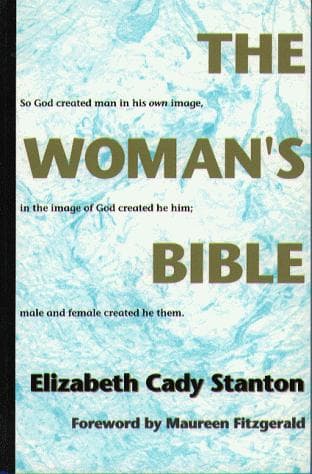
Bible -- Commentaries; Bible -- Feminist criticism; Women in the Bible
Since I have proposeed the elimination of some of the coarser portions
of Deuteronomy, I wish to add the testimony of Stevens in his
"Scripture Speculations," as to the general morality of this ancient
code. "Barbarous as they were in many things, childish in more, their
laws are as much in advance of them as of their contemporaries,--were
even singular for humanity in that age, and not always equaled in ours.
We forget that there were contemporary nations which justified
stealing, authorised infanticide, legalized the murder of aged parents,
associated lust with worship. None of these blots can be traced on the
Jewish escutcheon. By preventing imprisonment for debt, Moses
anticipated the latest discovery of modern philanthropy. * * * Even the
mercy of Christianity was foreshadowed in his provision for the poor,
who were never to cease out of the land; the prospered were to lend
without interest, and never to harden their heart against a brother.
The hovel of the poor was a sanctuary, and many a minute safeguard like
the return of the debtor's garment at nightfall, to save him from
suffering during the chilliness of the night, has waited to be brought
to light by our more perfect knowledge of Jewish customs." But that the
Scriptures, rightly interpreted, do not teach the equality of the
sexes, I must be permitted to doubt. We who love the Old and New
Testaments take "Truth for authority, and not authority for truth," as
did our sainted Lucretia Mott, whose earnest appeals for liberty were
often jewelled, as were Daniel Webster's most eloquent speeches, with
some texts from the old Hebrew Bible.
P. A. H.
CHAPTER VI.
THE PENTATEUCH.
The primal requisite for the more accurate understanding of the Bible
is its translation from the past to the present tense. It has been
studied as history, as the record of a remote past whose truth it has
been well-nigh impossible to verify. It should be studied as a record
of the present, the present experience of the individual and the race
which is to ultimate in the perfect actualization of generic
possibilities.
Like the tables of stone the Bible is written on both sides; or it has
a letter which is its exterior and an interior spirit or meaning. The
history which constitutes its letter illustrates those principles which
constitute its meaning. The formless must be put into form to be
apprehended. Mistaking the form for that substance which has been
brought to the level of human apprehension by its means, is the error
which constitutes the basis of dogmatic theology. Error in a premise
compels error in conclusions. It is no wonder that woman's true
relation to man and just position in the social fabric has remained
unknown. A Moses on Pisgah's height is needed to-day to see and declare
this promised land; and he must be revelator, first, to women
themselves, for they especially need enlightenment upon the true nature
of the Bible.
Public-domain text, read in full here on John Shaqi.
Reviews
Reviews
No reviews yet
Be the first to share your thoughts on this work.
Elsewhere in the archive
Join the Discussion
Join the discussion
Sign in to leave a comment or review.
Sign InorCreate an account