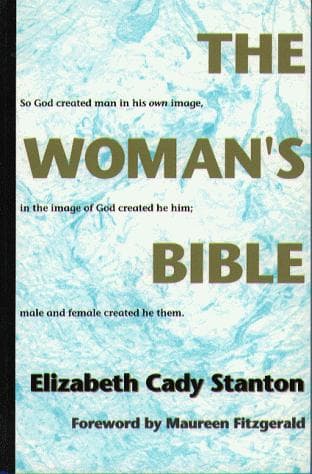
Bible -- Commentaries; Bible -- Feminist criticism; Women in the Bible
General Weyler, in his Cuban warfare, has, in many respects, a
prototype in General Gideon, and also in General Jephthah, "a mighty
man of valor" and "the son of a harlot," as the author of the Book of
Judges declares him to have been. We deprecate the savage butchery of
the one--what ought we to say of the renown of the others? War is
everywhere terrible, and "deeds of violence and of blood" are sad
reminders of the imperfections of mankind. The men of those "colonial
days" were far from being patterns of excellence; and the women
"matched the men," in most instances. Deborah, as a "mother in Israel,"
won deserved renown, so that her song of victory is even now rehearsed,
but it is a query that can have but one answer, whether her anthem of
triumph is not a musical rehearsal of treacherous and warlike deeds,
unworthy of a woman's praise?
In the Book of judges Delilah appears, and if the mother of her strong
lover, Samson, was not a perfect woman, in the modern sense, she has
helped to make some readers feel that the law of heredity is a revealer
of secrets, and that the story of the angel of the Lord may be received
with due caution. The name "Delilah" has become a synonym for a woman
tempting to sin, and the moral weakness and physical strength of Samson
show the power of heredity. But whether the stories should be in the
hands of our youth, without sufficient explanation and wise
commentaries, is a question which coming days will solve to the extent
of a wise elimination. Solemn lessons, and those of moral import, are
given in the Book of Judges; yet, as a whole, the book does not leave
one with an exalted opinion of either the men or the women of those
days. But it certainly gives no evidence that in shrewdness, in a wise
adaptation of means to ends, in a persistent effort after desired
objects, in a successful accomplishment of plans and purposes, the
women were the inferiors of the men in that age. They appear to have
been their equals, and occasionally their superiors.
P. A. H.
THE BOOK OF RUTH.
Ruth i.
1 Now it came to pass in the days when the judges ruled, that there
was a famine in the land. And a certain man of Bethlehem--Judah went to
sojourn in the country of Moab, he, and his wife, and his two sons.
2 And the name of the man was Elimelech, and the name of his wife
Naomi, and the name of his two sons Mahlon and Chilion. And they came
into the country of Moab, and continued there.
3 And Elimelech, Naomi's husband, died; and she was left, and her two
sons.
4 And they took them wives of the women of Moab; the name of the one
was Orpah, and the name of the other Ruth: and they dwelt there about
ten years.
5 And Mahlon and Chilion died also both of them; and the woman was
left of her two sons and her husband.
6 Then she arose with her daughters in law, that she might return from
the country of Moab; for she had heard in the country of Moab how that
the Lord had visited his people in giving them bread.
Public-domain text, read in full here on John Shaqi.
Reviews
Reviews
No reviews yet
Be the first to share your thoughts on this work.
Elsewhere in the archive
Join the Discussion
Join the discussion
Sign in to leave a comment or review.
Sign InorCreate an account