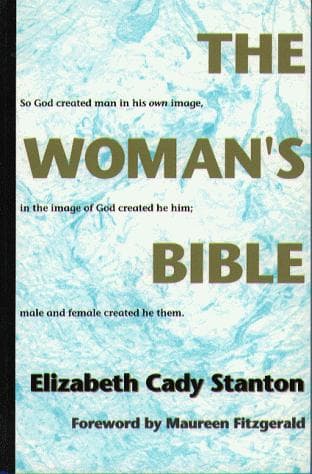
Bible -- Commentaries; Bible -- Feminist criticism; Women in the Bible
The Bible is an occult book, and a remarkable one. About all creeds
and faiths this side of Pagandom go to it for their authority. Read in
the light of occult teachings, it becomes something more than the old
battle ground of controversy for warring religions. Occultism alone
furnishes the key to this ancient treasury of wisdom. But to turn now
to another point, it may be well to call the attention of the readers
of The Woman's Bible to a few quotations from MacGregor Mathers'
"Kabbalah Unveiled," which has been pronounced by competent authorities
the work of a master hand. This work is a translation of Knorr Von
Rosenroth's "Kabbalah Denudata."
The Kabbalah--the Hebrew esoteric doctrines--is a system of teachings
with which only the very learned attempt to wrestle. It is claimed to
have been handed down by oral tradition from angelic sources, through
Adam, Noah, Abraham, Moses, the Seventy Elders, to David and to
Solomon. No attempt was made to commit this sacred knowledge to
writing, till, in the early centuries of the Christian era (authorities
differ widely as to the date) the pupils of Rabbi Simeon ben Joachi put
his teachings into writing; and this in later ages became known as the
"Zohar," or "Book of Splendor." Around the name of this Rabbi Simeon
ben Joachi, as one scholarly writer puts it, "cluster the mystery and
the poetry of the religion of the Kabbalah as a gift of the Deity to
mankind." The Zohar, which is only a part of the Kabbalah, is the great
store-house of the esoteric teaching of the ancient Hebrews.
Returning to the quotations referred to above, MacGregor Mathers in
his preface says: "I wish particularly to direct the reader's attention
to the stress laid by the Kabbalah on the feminine aspects of the
Deity, and to the shameful way in which any allusion to these has been
suppressed in the ordinary translations of the Bible, also to the
Kabbalistical equality of male and female."
Referring to the Sephiroth (the ten Kabbalistical attributes of God),
Mr. Mathers says:
"Among these Sephiroth, jointly and severally, we find the development
of the persons and the attributes of God. Of these, some are male and
some are female. Now, for some reason or other, best known to
themselves, the translators of the Bible have carefully crowded out of
existence and smothered up every reference to the fact that the Deity
is both masculine and feminine. They have translated a feminine plural
by a masculine singular in the case of the word Elohim. They have,
however, left an inadvertent admission of their knowledge that it was
plural in Genesis iv., 26: 'And Elohim said: Let US make man.'
Public-domain text, read in full here on John Shaqi.
Reviews
Reviews
No reviews yet
Be the first to share your thoughts on this work.
Elsewhere in the archive
Join the Discussion
Join the discussion
Sign in to leave a comment or review.
Sign InorCreate an account