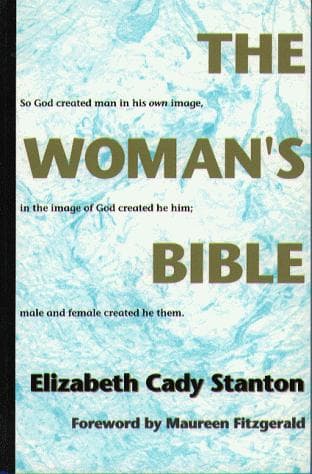
Bible -- Commentaries; Bible -- Feminist criticism; Women in the Bible
The Rev. Dr. Edwin Hatch expresses the latest decision of historical
theology concerning Paul, in frankly confessing: "His life at Rome and
all the rest of his history are enveloped in mists from which no single
gleam of certain light emerges. . . . The place and occasion of his
death are not less uncertain than are the facts of his later life. . .
The chronology of the rest of his life is as uncertain as the date of
his death. We have no means of knowing when he was born, or how long he
lived, or at what date the several events of his life took place."
Exactly the same may be said of Peter. The strongest probability is
that Paul and Peter were two obscure men who lived in the latter part
of the first, or beginning of the second century, neither of whom could
have seen the first century Jesus. It can easily be shown that the
Christian Church admitted women into her regularly ordained ministry
during the first two hundred years of Christianity. Whether Bishop
Doane is ignorant of this fact, or whether he is merely presuming upon
women's ignorance thereof, it is impossible to say. But one thing is
clear, and that is, that the time has arrived when all women should be
informed of the true status of their sex in the ministry of the
primitive Church.
The first important truth for them to learn concerning the question is
that there is a missing link of some five hundred years between the
close of that body of literature known to us as the "Old Testament" and
the compilation of that collection of letters, narratives, etc., now
presented to us as the "New Testament." Girls of Christian families are
commonly inoculated in their ignorant, and therefore helplessly
credulous youth, with unquestioning belief that the New Testament was
written in the first century of our era, by disciples who were
contemporary with Jesus, and that Peter and Paul were first century
Christians, the former of whom had personally known and followed Jesus,
while the latter was a convert from Judaism after Jesus' death, never
having seen the teacher himself.
Yet he is, indeed, a very ignorant ecclesiastic, who to-day is not
perfectly well aware that the above belief is pure theory, resting on
nothing more stable than vague conjecture, irresponsible tradition, and
slowly evolving fable. Among scholarly Christian theologians no
questions are now more unsettled than are the queries: Who wrote the
Gospels? In which of the first three centuries did they assume their
present shape? And at what time did Peter and Paul live and quarrel
with each other concerning Christian polity?
Public-domain text, read in full here on John Shaqi.
Reviews
Reviews
No reviews yet
Be the first to share your thoughts on this work.
Elsewhere in the archive
Join the Discussion
Join the discussion
Sign in to leave a comment or review.
Sign InorCreate an account