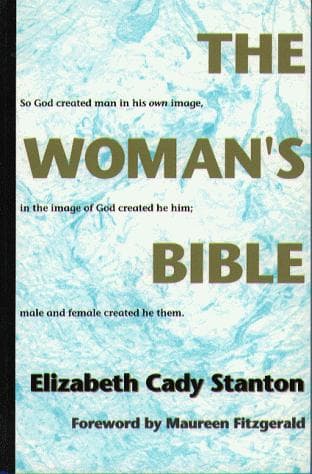
Bible -- Commentaries; Bible -- Feminist criticism; Women in the Bible
1 The elder unto the elect lady and her children,
5 And now I beseech thee, lady, not as though I wrote a new
commandment unto thee, but that which we had from the beginning, that
we love one another.
6 And this is love, that we walk after his commandments.
12 Having many things to write unto you, I would not write with paper
and ink; but I trust to come unto you, and speak face to face, that our
joy may be full.
Some critics conjecture that the Church at Jerusalem is meant by the
"elect lady," and the one at Ephesus by her elect sister. Others
suppose that an eminent and honorable Christian woman was intended by
the "elect lady," and that some other Christian woman, well known in
the Church, was intended by her elect sister. The aged Apostle wrote
this short letter to this lady, who was a person of rank, hence he did
not scruple to give to her the title of honor. He assured her children
of his deep interest in their welfare. The word lady was always used in
addressing, or speaking of one who was an acknowledged superior. In
their travels about the country the Apostles especially enjoyed the
hospitality of families of rank. Though democratic in their principles,
they were susceptible to the attractions of wealth and of culture.
E. C. S.
REVELATION.
CHAPTER I.
Revelation i.
The Revelation of Jesus Christ, which God gave unto him, to shew unto
his servants things which must shortly come to pass; and he sent and
signified it by his angel unto his servant John:
2 Who bare record of the word of God, and of the testimony of Jesus
Christ, and of all things that he saw.
3 Blessed is he that readeth, and they that hear the words of this
prophecy and keep those things which are written therein: for the time
is at hand.
4 John to the seven churches which are in Asia: Grace be unto you, and
peace, from him which is, and which was, and which is to come; and from
the seven Spirits which are before his throne.
John Morley once said to the priests--"We shall not attack you, we
shall explain you." The Book of Revelation, properly Re-Veilings,
cannot even be approximately explained without some knowledge of
astrology. It is a purely esoteric work, largely referring to woman,
her intuition, her spiritual powers, and all she represents. Even the
name of its putative author, John, is identical in meaning with "dove,"
the emblem of the Holy Ghost, the female principle of the Divinity.
This book came down from old Egyptian "mystery" times, and was one of
the profoundly "sacred" and profoundly "secret" books of the great
temple of Luxor, the words "sacred" and "secret" possessing the same
meaning during the mysteries. All knowledge was anciently concealed in
the mysteries; letters, numbers, astrology (until the sixteenth century
identical with astronomy), alchemy, the parent of chemistry, these, and
all other sciences were hidden from the common people. Even to all
initiates the most important part of the mysteries was not revealed.
Public-domain text, read in full here on John Shaqi.
Reviews
Reviews
No reviews yet
Be the first to share your thoughts on this work.
Elsewhere in the archive
Join the Discussion
Join the discussion
Sign in to leave a comment or review.
Sign InorCreate an account