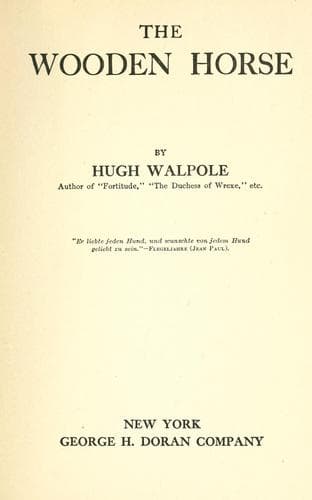
Cornwall (England : County) -- Fiction; Fathers and sons -- Fiction
Afterwards, on looking back, he felt that his expectations had been
perfectly justified; she had, up to that point, given him every reason
to take the line that he adopted. She had listened to the first part
of his speech without remark; she must, he reflected afterwards, have
known what was coming, yet she had given no sign that she heard.
And so the change in her was startling and took him utterly by surprise.
She looked up at him from her chair, and the thin ghost of a smile that
crept round the corners of her mouth, faced him for a moment, and then
vanished suddenly, was the strangest thing that he had ever seen.
"Don't you think, Mr. Trojan, that that is a little insulting?"
It made him feel utterly ashamed. In her own house, in her
drawing-room, he had offered her money.
"I beg your pardon," he stammered.
"Yes," she answered slowly. "You had rather misconceived the
situation."
Harry felt that her silences were the most eloquent that he had ever
known. He began to be very frightened, and, for the first time,
conceived the possibility of not securing the letters at all. The
thought that his hopes might be dashed to the ground, that he might be
no nearer his goal at the end of the interview than before, sharpened
his wits. It was to be a deal in subtlety rather than the obvious
thing that he had expected--well, he would play it to the end.
"I beg your pardon," he said again. "I have been extremely rude. I am
only recently returned from abroad, and my knowledge of the whole
affair is necessarily very limited. I came here with a very vague idea
both as to yourself and your intentions. In drawing the conclusions
that I did I have done both you and your daughter a grave injustice,
for which I humbly apologise. I may say that, before coming here, I
had had no interview with my son. I am, therefore, quite ignorant as
regards facts."
He did not feel that his apology had done much good. He felt that she
had accepted both his insult and apology quite calmly, as though she
had regarded them inevitably.
"The facts," she said, looking down again at the fire, "are quite
simple. My daughter and your son became acquainted at Cambridge in May
last. They saw a great deal of each other during the next few months.
At the end of that time they were engaged. Mr. Robert Trojan gave us
to understand that he was about to acquaint his family with the fact.
They corresponded continually during the summer--letters, I believe, of
the kind common to young people in love. Mr. Robert Trojan spoke
continually of the marriage and suggested dates. We then came down
here, and, soon after our arrival, I perceived a change in your son's
attitude. He came to see us very rarely, and at last ceased his visits
altogether. My daughter was naturally extremely upset, and there were
several rather painful interviews. He then wrote returning her letters
and demanding the return of his own. This she definitely refused.
Those are the facts, Mr. Trojan."
Public-domain text, read in full here on John Shaqi.
Reviews
Reviews
No reviews yet
Be the first to share your thoughts on this work.
Elsewhere in the archive
Join the Discussion
Join the discussion
Sign in to leave a comment or review.
Sign InorCreate an account