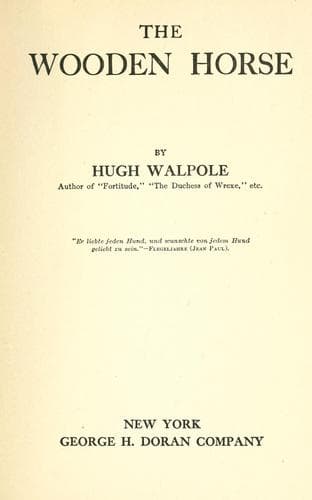
Cornwall (England : County) -- Fiction; Fathers and sons -- Fiction
Harry had learnt to listen in silence. He knew, for one thing, that no
one would pay very much attention if he did speak, and then, of late,
he had been flung very much into himself and his reserve had grown from
day to day. People did not want to listen to him--well, he would not
trouble them. He felt, too, as Newsome had once said to him, that he
belonged properly to "down-along," and he knew that he was out of touch
with the whole of that modern movement that was going on around him.
But sometimes, as he listened, his cheeks burned when they talked of
the Cove, and he longed to jump up and plead its defence; but he knew
that it would be worse than useless and he held himself in--but they
didn't know, they didn't know. It enraged him most when they spoke of
it as some lifeless, abstract thing, some old rubbish-heap that
offended their sight, and then he thought of its beauties, of the
golden sand and the huddling red and grey cottages clustering over the
sea as though for protection. You might fancy that the waves slapped
them on the back for good-fellowship when they dashed up against the
walls, or kissed them for love when they ran in golden ripples and
softly lapped the stones.
On the second night after his visit to Dahlia Feverel, Harry went down,
after dinner, to the Cove. He found those evening hours, before going
to bed, intolerable at the House. The others departed to their several
rooms and he was suffered to go to his, but the loneliness and
dreariness made reading impossible and his thoughts drove him out. He
had lately been often at the Inn, for this was the hour when it was
full, and he could sit in a corner and listen without being forced to
take any part himself. To-night a pedlar and a girl--apparently his
daughter--were entertaining the company, and even the melancholy sailor
with one eye seemed to share the feeling of gaiety and chuckled
solemnly at long intervals. It was a scene full of colour; the lamps
in the window shone golden through the haze of smoke on to the black
beams of the ceiling, the dust-red brick of the walls and floor, and
the cavernous depths of the great fireplace. Sitting cross-legged on
the table in the centre of the room was the pedlar, a little, dark,
beetle-browed man, and at his side were his wares, his pack flung open,
and cloths of green and gold and blue and red flung pell-mell at his
side. Leaning against the table, her hands on her hips, was the girl,
dark like her father, tall and flat-chested, with a mass of black hair
flung back from her forehead. No one knew from what place they had
come nor whither they intended to go--such a visit was rare enough in
these days of trains--and the little man's reticence was attacked again
and again, but ever unsuccessfully. There were perhaps twenty sailors
in the room, and they sat or stood by the fireplace watching and
listening.
Harry slipped in and took his place by Newsome in the corner.
"I will sing," said the girl.
Public-domain text, read in full here on John Shaqi.
Reviews
Reviews
No reviews yet
Be the first to share your thoughts on this work.
Elsewhere in the archive
Join the Discussion
Join the discussion
Sign in to leave a comment or review.
Sign InorCreate an account