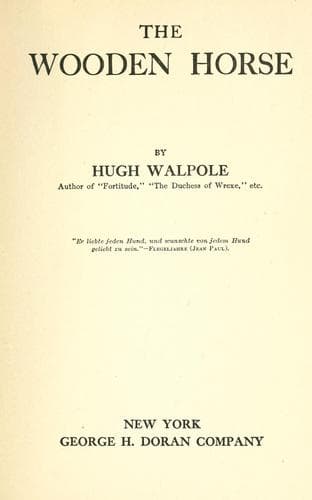
Cornwall (England : County) -- Fiction; Fathers and sons -- Fiction
He was immediately aware that he had said nothing to Randal about the
Feverel affair and he wondered why. Randal would have been the natural
person to talk to about it; his advice would have been worth having.
But Robin felt vaguely that it would be better not. For some strange
reason, as yet unanalysed, he scarcely trusted him as he had done in
the old days. He was still wondering why, when they arrived at the
station.
They said good-bye affectionately--rather more affectionately than
usual. There was a little sense of strain, and Robin felt relieved
when the train had gone. As he hurried from the platform he puzzled
over it. He could hold no clue, but he knew that their friendship had
changed a little. He was sorry.
As he turned down the station road he decided that life was becoming
very complicated. There was first his father; that oughtn't in the
nature of things to have complicated matters at all--but it was
complicated, because there was no knowing what a man like that would
do. He might let the family down so badly; it was almost like having
gunpowder in your cellar. Randal had thought him absurd. Robin saw
that clearly, and Randal's opinion was that of all truly sensible
people. But, after all, the real complication was the Feverel affair.
It was now nearly ten days since that terrible evening and nothing had
happened. Robin wasn't sure what _could_ have happened, but he had
expected something. He had waited for a note; she would most assuredly
write and her letter would serve as a hint, he would know how to act;
but there had been no sign. On the day following the interview he had
felt, for the most part, relief. He was suddenly aware of the burden
that the affair had been, he was a free man; but with this there had
been compunction. He had acted like a brute; he was surprised that he
could have been so hard, and he was a little ashamed of meeting the
public gaze. If people only realised, he thought, what a cad he was,
they would assuredly have nothing to do with him. As the days passed,
this feeling increased and he was extremely uncomfortable. He had
never before doubted that he was a very decent fellow--nothing,
perhaps, exceptional in any way, but, judged by every standard, he
passed muster. Now he wasn't so sure, he had done something that he
would have entirely condemned in another man, and this showed him
plainly and most painfully the importance that he placed on the other
man's opinion. He was beginning to grow his crop of ideas and he was
already afraid of the probable harvest.
Public-domain text, read in full here on John Shaqi.
Reviews
Reviews
No reviews yet
Be the first to share your thoughts on this work.
Elsewhere in the archive
Join the Discussion
Join the discussion
Sign in to leave a comment or review.
Sign InorCreate an account