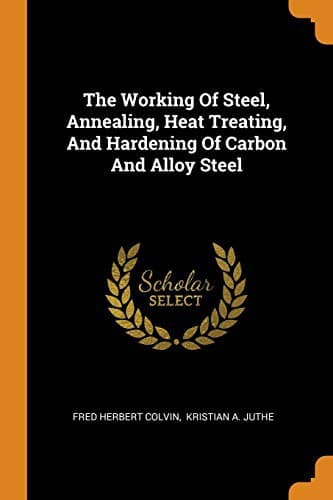
The Working of Steel: Annealing, Heat Treating and Hardening of Carbon and Alloy SteelColvin, Fred H. (Fred Herbert)
Science
The Working of Steel: Annealing, Heat Treating and Hardening of Carbon and Alloy Steel
Colvin, Fred H. (Fred Herbert)
Steel
The work is heated up slowly in the furnace and the magnet applied
from time to time. The steel being heated will attract the magnet
until the heat reaches the critical point. The magnet is applied
frequently and when the magnet is no longer attracted, the piece
is at the lowest temperature at which it can be hardened properly.
Quenching slightly above this point will give a tool of satisfactory
hardness. The method applies only to carbon steels and will not
work for modern high-speed steels.
HEAT TREATMENT OF GEAR BLANKS
This section is based on a paper read before the American Gear
Manufacturers' Association at White Sulphur Springs, W. Va., Apr.
18, 1918.
Great advancement has been made in the heat treating and hardening of
gears. In this advancement the chemical and metallurgical laboratory
have played no small part. During this time, however, the condition
of the blanks as they come to the machine shop to be machined has
not received its share of attention.
There are two distinct types of gears, both types having their
champions, namely, carburized and heat-treated. The difference
between the two in the matter of steel composition is entirely in
the carbon content, the carbon never running higher than 25-point
in the carburizing type, while in the heat-treated gears the carbon
is seldom lower than 35-point. The difference in the final gear
is the hardness. The carburized gear is file hard on the surface,
with a soft, tough and ductile core to withstand shock, while the
heat-treated gear has a surface that can be touched by a file with
a core of the same hardness as the outer surface.
ANNEALING WORK.--With the exception of several of the higher types
of alloy steels, where the percentages of special elements run quite
high, which causes a slight air-hardening action, the carburizing
steels are soft enough for machining when air cooled from any
temperature, including the finishing temperature at the hammer.
This condition has led many drop-forge and manufacturing concerns
to consider annealing as an unnecessary operation and expense.
In many cases the drop forging has only been heated to a low
temperature, often just until the piece showed color, to relieve
the so-called hammer strains. While this has been only a compromise
it has been better than no reheating at all, although it has not
properly refined the grain, which is necessary for good machining
conditions.
Annealing is heating to a temperature slightly above the highest
critical point and cooling slowly either in the air or in the furnace.
Annealing is done to accomplish two purposes: (1) to relieve mechanical
strains and (2) to soften and produce a maximum refinement of grain.
Public-domain text, read in full here on John Shaqi.
Reviews
Reviews
No reviews yet
Be the first to share your thoughts on this work.
Elsewhere in the archive
Join the Discussion
Join the discussion
Sign in to leave a comment or review.
Sign InorCreate an account