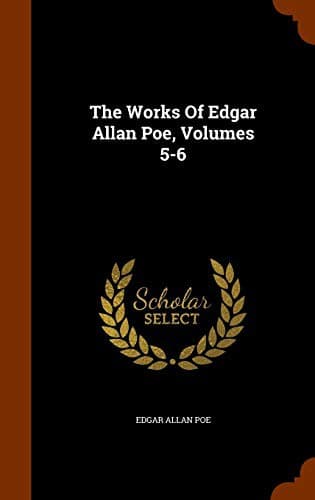
The Works of Edgar Allan Poe — Volume 5Poe, Edgar Allan
General
The Works of Edgar Allan Poe — Volume 5
Poe, Edgar Allan
American fiction -- 19th century; American poetry; Fantasy fiction; Horror tales, American
It should not be doubted that at least one-third of the affection with
which we regard the elder poets of Great Britain should be-attributed to
what is, in itself, a thing apart from poetry-we mean to the simple love
of the antique-and that, again, a third of even the proper _poetic
sentiment inspired_by their writings should be ascribed to a fact
which, while it has strict connection with poetry in the abstract, and
with the old British poems themselves, should not be looked upon as a
merit appertaining to the authors of the poems. Almost every devout
admirer of the old bards, if demanded his opinion of their productions,
would mention vaguely, yet with perfect sincerity, a sense of dreamy,
wild, indefinite, and he would perhaps say, indefinable delight; on being
required to point out the source of this so shadowy pleasure, he would be
apt to speak of the quaint in phraseology and in general handling. This
quaintness is, in fact, a very powerful adjunct to ideality, but in the
case in question it arises independently of the author’s will, and is
altogether apart from his intention. Words and their rhythm have varied.
Verses which affect us to-day with a vivid delight, and which delight, in
many instances, may be traced to the one source, quaintness, must have
worn in the days of their construction, a very commonplace air. This is,
of course, no argument against the poems now-we mean it only as against
the poets _thew. _There is a growing desire to overrate them. The old
English muse was frank, guileless, sincere, and although very learned,
still learned without art. No general error evinces a more thorough
confusion of ideas than the error of supposing Donne and Cowley
metaphysical in the sense wherein Wordsworth and Coleridge are so. With
the two former ethics were the end-with the two latter the means. The poet
of the “Creation” wished, by highly artificial verse, to inculcate what he
supposed to be moral truth-the poet of the “Ancient Mariner” to infuse the
Poetic Sentiment through channels suggested by analysis. The one finished
by complete failure what he commenced in the grossest misconception; the
other, by a path which could not possibly lead him astray, arrived at a
triumph which is not the less glorious because hidden from the profane
eyes of the multitude. But in this view even the “metaphysical verse” of
Cowley is but evidence of the simplicity and single-heartedness of the
man. And he was in this but a type of his school-for we may as well
designate in this way the entire class of writers whose poems are bound up
in the volume before us, and throughout all of whom there runs a very
perceptible general character. They used little art in composition. Their
Public-domain text, read in full here on John Shaqi.
Reviews
Reviews
No reviews yet
Be the first to share your thoughts on this work.
Elsewhere in the archive
Join the Discussion
Join the discussion
Sign in to leave a comment or review.
Sign InorCreate an account