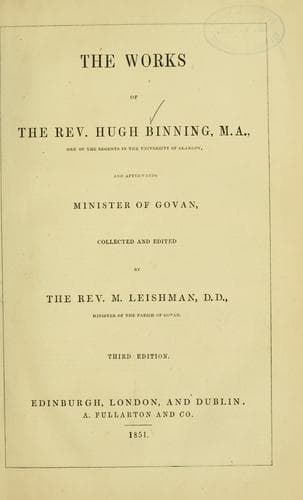
Presbyterian Church -- Sermons; Sermons, English; Theology -- Early works to 1800; Theology -- History -- 17th century
Believers are “the temple of the living God,” in which he dwells and
walks, 2 Cor. vi. 16. Every one of them is a little sanctuary and temple
to his Majesty, “sanctify the Lord of hosts in your hearts.” Though he be
“the high and lofty One that inhabits eternity,” yet he is pleased to come
down to this poor cottage of a creature’s heart, and dwell in it. Is not
this as great a humbling and condescending for the Father to come down off
his throne of glory, to the poor base footstool of the creature’s soul, as
for the Son to come down in the state of a servant, and become in the form
of sinful flesh? But then he is a temple and sanctuary to them. “And he
shall be for a sanctuary,” (Isa. viii. 14.) a place of refuge, a secret
hiding place. Now, as every one is a little separated retired temple, so
they all conjoined make up one temple, one visible body, in which he
dwells. Therefore Peter calls them “living stones built up a spiritual
house” to God, 1 Pet. ii. 5. All these little temples make up one house
and temple fitly joined together, in which God shows manifest signs of his
presence and working. Unto this the apostle in this place alludes. The
communion and union of Christians with God is of such a nature, that all
the relations and points of conjunction in the creatures are taken to
resemble it and hold it out to us. We are citizens, saith he, and
domestics, household-men, and so dwell in his house, and then we are this
house besides. Now ye know there are two principal things in a house—the
foundation and the cornerstone, the one supports the building the other
unites it and holds it together. These two parts of this spiritual
building are here pointed at. The foundation of every particular stone,
and of the whole building, is the doctrine of the prophets and apostles,
as holding out Jesus Christ to souls, “the rock on which our house shall
be builded,” not the apostles or prophets, far less pastors and teachers
since,—for they are but at best, “workers together with God, and employed
in the building of the house,” nor yet their doctrine, but as it holds out
that “sure foundation” that God has laid in Zion, (Isa. xxviii. 16.) which
is Jesus Christ for “other foundation can no man lay.” And then, “the
corner stone” is that same Jesus Christ, who reaches from the bottom even
to the top of the building, and immediately touches every stone, and both
quickens it in itself, and unites them together.
Public-domain text, read in full here on John Shaqi.
Reviews
Reviews
No reviews yet
Be the first to share your thoughts on this work.
Elsewhere in the archive
Join the Discussion
Join the discussion
Sign in to leave a comment or review.
Sign InorCreate an account