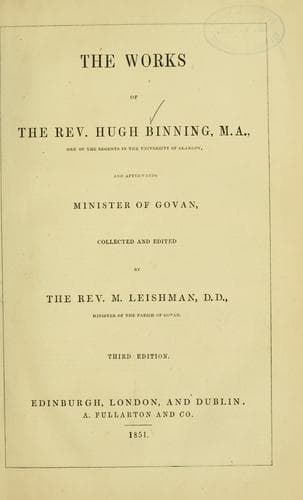
Presbyterian Church -- Sermons; Sermons, English; Theology -- Early works to 1800; Theology -- History -- 17th century
their authority! Therefore when a temptation cometh, from any gainsayings
of the truth,—you cannot stand against it, because your faith hath no
foundation but the sayings of men, or acts of assemblies. And therefore,
as men whom you trust with holding out light unto you, hold out darkness
instead of light, you embrace that darkness also. But, I beseech you, be
builded upon the foundation of the apostles and prophets, not upon _them_,
but upon that whereon they were builded, the infallible truths of God. You
have the Scriptures, search them; since you have reasonable souls, search
them. Other men’s faith will not save; you cannot see to walk to heaven by
other men’s light, more than you can see by their eyes. You have eyes of
your own, souls of your own, subordinate to none but the God of spirits,
and the Lord of consciences, Jesus Christ, and therefore examine all that
is spoken to you from the word, according to the word, and receive no more
upon trust from men but as you find it upon trial to be the truth of God.
Lecture VI.
What The Scriptures Principally Teach: The Ruin And Recovery Of Man. Faith
And Love Towards Christ.
2 Tim. i. 13.—“Hold fast the form of sound words, which thou hast
heard of me, in faith and love which is in Christ Jesus.”
Here is the sum of religion. Here you have a compend of the doctrine of
the Scriptures. All divine truths may be reduced to these two heads,—faith
and love; what we ought to believe, and what we ought to do. This is all
the Scriptures teach, and this is all we have to learn. What have we to
know, but what God hath revealed of himself to us? And what have we to do,
but what he commands us? In a word, what have we to learn in this world,
but to believe in Christ, and love him, and so live to him? This is the
duty of man, and this is the dignity of man, and the way to eternal life.
Therefore the Scriptures, that are given to be “a lamp to our feet, and a
guide to our paths,” contain a perfect and exact rule,—_credendorum et
faciendorum_,—of faith and manners,—of doctrine and practice. We have in
the scriptures many truths revealed to us of God, and of the works of his
hands,—many precious truths, but that which most of all concerns us, is to
know God and ourselves. This is the special excellency of the reasonable
creature, that it is made capable to know its Creator, and to reflect upon
its own being. Now, we have to know ourselves, what we are now, and what
man once was, and accordingly to know of God, what he once revealed of
himself, and what he doth now reveal. I say, the Scriptures hold out to
our consideration a twofold estate of mankind, and according to these, a
twofold revelation of the mystery of God. We look on man now, and we find
him another thing than he was once, but we do not find God one thing at
one time, and another thing at another time, for there is no “shadow of
change” in him, and “he is the same yesterday, and to-day, and for ever.”
Public-domain text, read in full here on John Shaqi.
Reviews
Reviews
No reviews yet
Be the first to share your thoughts on this work.
Elsewhere in the archive
Join the Discussion
Join the discussion
Sign in to leave a comment or review.
Sign InorCreate an account