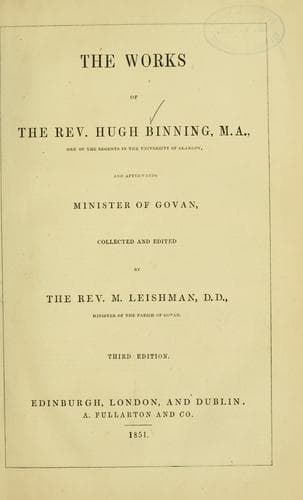
Presbyterian Church -- Sermons; Sermons, English; Theology -- Early works to 1800; Theology -- History -- 17th century
sleep of a drunken man, who, even when he sleeps, does not rest quietly.”
Now, although this inward stamp of a Deity be engraven on the minds of
all, and every creature without have some marks of his glory stamped on
them, so that all things a man can behold above him, or about him, or
beneath him, the most mean and inconsiderable creatures, are pearls and
transparent stones that cast abroad the rays of that glorious brightness
which shines on them, as if a man were enclosed into a city built all of
precious stones, that in the sunshine all and every parcel of it, the
streets, the houses, the roofs, the windows all of it, reflected into his
eyes those sunbeams in such a manner as it all had been one mirror—though,
I say, this be so, yet such is the blockishness and stupidity of men that
they do not, for all this, consider of the glorious Creator, so that all
these lamps seem to be lighted in vain to show forth his glory, which,
though they do every way display their beams upon us, that we can turn our
eye nowhere but such a ray shall penetrate it, yet we either do not
consider it, or the consideration of it takes not such deep root as to
lead home to God. Therefore the Scripture calls all natural men atheists.
They have “said in their heart, there is no God,” Psal. xiv. 1. All men
almost confess a God with their mouth, and think they believe in him, but
alas! behold their actions and hearts, what testimony they give for a
man’s walking and conversation is like an eye witness, that one of them
deserves more credit than ten ear-witnesses of professions,—_Plus valet
oculatus testis unus, quam auriti decem_. Now, I may ask of you, what
would ye do, how would ye walk, if ye believed there were no God? Would ye
be more dissolute and profane, and more void of religion? Would not human
laws bind you as much in that case as they now do? For that is almost all
the restraint that is upon many,—the fear of temporal punishment, or shame
among men. Set your walking beside a heathen’s conversation, and save that
you say, ye believe in the true God, and he denies him, there is no
difference. Your transgressions speak louder than your professions, “that
there is no fear of God before your eyes”, Psal. xxxvi. 1. Your practice
belies your profession, you “profess that you know God, but in works you
deny him,” saith Paul, Tit. i. 16 _Ore quod dicitis, opere negatis_.
Public-domain text, read in full here on John Shaqi.
Reviews
Reviews
No reviews yet
Be the first to share your thoughts on this work.
Elsewhere in the archive
Join the Discussion
Join the discussion
Sign in to leave a comment or review.
Sign InorCreate an account