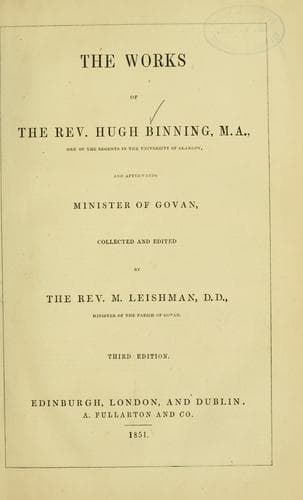
Presbyterian Church -- Sermons; Sermons, English; Theology -- Early works to 1800; Theology -- History -- 17th century
but consider the difference betwixt two beings, but you do not express how
far nothing is distant from any of them. Now, if any thing could be
imagined less than nothing, could you at all guess at the vast distance
between it and a being? so it is here. Thus saith the Lord, “all nations,”
their glory, perfection, and number, all of them, and all their
excellencies united,—do not amount to the value of an unit in regard of my
Majesty; all of them like ciphers, join never so many of them together,
they can never make up a number, they are nothing in this regard, and less
than nothing. So then, we ought thus to conceive of God, and thus to
attribute a being and life to him, as in his sight and in the
consideration of it all created beings might evanish out of our sight;
even as the glorious light of the sun, though it do not annihilate the
stars, and make them nothing, yet it annihilates their appearance to our
senses, and makes them disappear as if they were not. Although there be a
great difference and inequality of the stars in the night,—some lighter,
some darker, some of the first magnitude, and some of the second and
third, &c. some of greater glory, and some of less,—but in the day-time
all are alike, all are darkened by the sun’s glory, even so it is
here,—though we may compare one creature with another, and find different
degrees of perfection and excellency, while we are only comparing them
among themselves; but let once the glorious brightness of God shine upon
the soul, and in that light all these lights shall be obscured, all their
differences unobserved. An angel and a man, a man and a worm, differ much
in glory and perfection of being: but oh! in his presence there is no such
reckoning. Upon this account all things are alike, God infinitely distant
from all, and so not more or less. Infiniteness is not capable of such
terms of comparison. This is the reason why Christ says, “There is none
good but one, even God.” Why, because in respect of his goodness, nothing
deserves that name. Lesser light, in the view of the greater, is a
darkness, as less good in comparison of a greater appears evil; how much
more then shall created light and created goodness lose that name and
notion, in the presence of that “uncreated Light, and self-sufficient
Goodness.” And therefore it is, that the Lord calls himself after this
manner, “I am as if nothing else were. I will not say,” saith he, “that I
am the highest, the best and most glorious that is—that supposeth other
things to have some being, and some glory that is worthy the accounting
of—but I am, and there is none else; I am alone; I lift up my hand to
heaven, and swear I live for ever.” There is nothing else can say, I am, I
live, and there is nothing else; for there is nothing hath it of itself.
Can any boast of that which they have borrowed, and is not their own? As
if the bird that had stolen from other birds its fair feathers should come
Public-domain text, read in full here on John Shaqi.
Reviews
Reviews
No reviews yet
Be the first to share your thoughts on this work.
Elsewhere in the archive
Join the Discussion
Join the discussion
Sign in to leave a comment or review.
Sign InorCreate an account