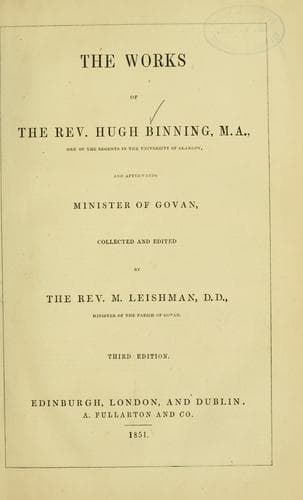
Presbyterian Church -- Sermons; Sermons, English; Theology -- Early works to 1800; Theology -- History -- 17th century
III. If God be a Spirit, then he is most perfect and most powerful. All
imperfection, all infirmity, and weakness in the creature, is founded in
the gross and material part of it. You see the more matter and bodily
substance is in any thing, it is the more lumpish, heavy, and void of all
action. It is the more spiritual, pure, and refined part of the creation
that hath most activity in it, and is the principle of all motions and
actions. You see a little fly hath more action in it than a great
mountain, because there are spirits in it which move it. The bottom of the
world contains the dregs of the creation, as it were,—a mass and lump of
heavy earth, but the higher and more distant bodies be from that, the more
pure and subtile they are, and the more pure and subtile they be, the more
action, virtue, and efficacy they have. The earth stands like a dead lump
but the sea moves, and the air being thinner and purer than both, moves
more easily and swiftly. But go up higher and still the motion is swifter,
and the virtue and influence is the more powerful. What is a dead body
when the soul and spirit is out of it? It hath no more virtue and efficacy
than so much clay, although by the presence of the spirit of it, it was
active, agile, swift, strong and nimble. So much then as any thing hath of
spirit in it, so much the more perfect and powerful it is. Then I beseech
you consider what a One the God of the spirits of all flesh must be,—the
very Fountain spirit,—the Self being spirit,—αυτο πνευμα. When the soul of
a man, or the spirit of a horse, hath so much virtue, to stir up a lump of
earth, and to quicken it to so many diverse operations, even though that
soul and spirit did not, nay could not make that piece of earth they dwell
in, then, what must his power and virtue be that made all those things?
Who gave power and virtue even to the spirits of all flesh? “Their horses”
saith God, are “flesh and not spirit,” (Isa. xxxi. 3) because, in
comparison of his majesty, the very spirits in them are but like a dead
lump of flesh. If he should draw in his breath, as it were, they would
have no more virtue to save the Israelites, than so many lumps of flesh or
clay. For he is the Spirit of all spirits, that quickens, actuates and
moves them to their several operations and influences. _Anima mundi, et
Anima animarum mundi_. An angel hath more power than all men united in one
body. Satan is called the prince of the air, and the god of this world,
for he hath more efficacy and virtue to commove the air, and raise
tempests than all the swarms of multiplied mankind, though gathered into
one army. If the Lord did not restrain and limit his power, he were able
to destroy whole nations at once. An angel killed many thousands of
Sennacherib’s army in one night, what would many angels do then, if the
Lord pleased to apply them to that work? O what is man that he should
magnify himself, or glory in strength, or skill? Beasts are stronger than
Public-domain text, read in full here on John Shaqi.
Reviews
Reviews
No reviews yet
Be the first to share your thoughts on this work.
Elsewhere in the archive
Join the Discussion
Join the discussion
Sign in to leave a comment or review.
Sign InorCreate an account