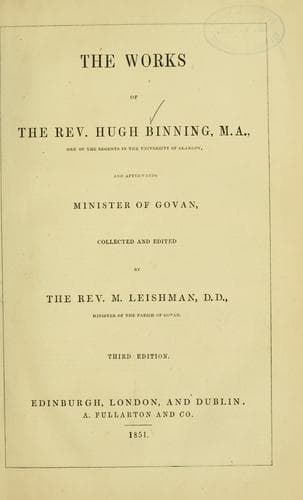
Presbyterian Church -- Sermons; Sermons, English; Theology -- Early works to 1800; Theology -- History -- 17th century
external and bodily worship—to any service to which our outward man is
instrumental. That is one of the deep delusions of this age, into which
some men, “reprobate concerning the faith,” have fallen, that there should
be no external ordinances, but that Christians are now called to a worship
all spirit, pure spirit, &c. This is one of the spirits, and spiritual
doctrines (that call themselves so) which ye must not receive, for it is
neither the Spirit of God nor of Christ that teacheth this. Not the Spirit
of God the Creator, because he hath made the whole man, body and soul, and
so must be worshipped of the whole man. He hath created man in such a
capacity as he may offer up external actions in a reasonable manner, with
the inward affections. As the Lord hath created him, so should he serve
him—every member every part in its own capacity,—the soul to precede, and
the body to follow,—the soul to be the chief worshipper, and the body its
servant employed in the worship. True worship hath a body and a soul as
well as a true man, and as the soul separated is not a complete man, so
neither is the soul separated a complete worshipper without the body. The
external ordinances of God is the body, the inward soul affection is the
spirit, which being joined together make complete worship. Neither is it
the Spirit of Christ which teacheth this, because our Lord Jesus hath
taught us to offer up our bodies and spirits both as a reasonable service,
Rom. xii. 1, 2. The sacrifice of the bodily performance offered up by the
spiritual affection and renewed mind is a living sacrifice, holy,
acceptable and reasonable. That Spirit which dwelt in Christ above
measure, did not think it too base to vent itself in the way of external
ordinances. He was, indeed, above all, above the law, yet did willingly
come under them to teach us, who have so much need and want, to come under
them. He prayed much, he preached, he did sing and read, to teach us how
to worship, and how much need we have of prayer and preaching. This was
not the spirit Christ promised to his disciples and apostles, which spirit
did breathe most lively in the use of external ordinances all their days,
and this is not the spirit which was at that hour in which Christ spoke
“the hour is come and now is,” ver. 23, in which the true worship of God
shall not be in the external Jewish ceremonies and rites, void of all life
and inward sense of piety, but the true worship of God shall be made up of
a soul and body,—of spirit and truth—of the external appointed ordinances
according to the word of truth, and the spirit of truth,—and of the spirit
and inward soul-affection and sincerity which shall quicken and actuate
that external performance. There were no such worshippers then as had no
use of ordinances. Christ was not such, his disciples were not such,
therefore it is a new gospel, which, if an angel should bring from heaven,
ye ought not to receive it.
Public-domain text, read in full here on John Shaqi.
Reviews
Reviews
No reviews yet
Be the first to share your thoughts on this work.
Elsewhere in the archive
Join the Discussion
Join the discussion
Sign in to leave a comment or review.
Sign InorCreate an account