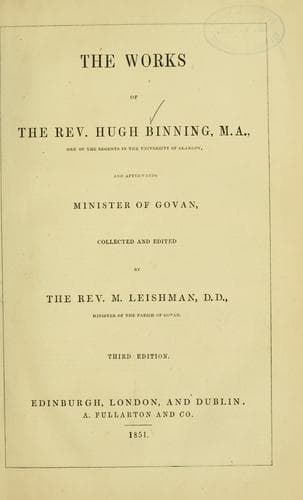
Presbyterian Church -- Sermons; Sermons, English; Theology -- Early works to 1800; Theology -- History -- 17th century
Christ, and the testimony of the Spirit in our consciences, bearing
witness to our spirits, is an assured testimony of this, that Jesus
Christ, in whom we believe, is “the Only Begotten of the Father, full of
grace and truth.” The changing, pacifying, and comforting of souls in such
a wonderful manner, cries aloud that he in whom the soul believes is the
true and living God, whom to know is eternal life. But mark, I pray you,
the accuracy of the apostle in the change of speech. “These three”
witnesses on earth, saith he, “agree in one, in giving one common
testimony to the Son of God and the Saviour of sinners.” But as for the
heavenly witnesses—the Father, the Word and the Holy Ghost,—however they
be three after an inconceivable manner, and that they do also agree in one
common testimony to the Mediator of men, yet moreover they are One. They
not only agree in one but are one God,—one simple, undivided, self-being,
infinite Spirit,—holden out to us in three persons, the Father, Son, and
Holy Ghost, to whom be praise and glory.
Lecture XIII.
Of The Unity Of The Godhead And The Trinity Of Persons
Deut. vi. 4.—“Hear, O Israel The Lord our God is one Lord.”—1 John
v. 7 “There are three that bear record in heaven the Father, the
Word, and the Holy Ghost and these three are one.”
“All Scripture is given by inspiration of God, and is profitable for
doctrine, for reproof, for correction, for instruction in righteousness,”
2 Tim. iii. 16. There is no refuse in it, no simple and plain history, but
it tends to some edification, no profound or deep mystery, but it is
profitable for salvation. Whatsoever secrets there be in the mysteries of
God which are reserved from us, though it be given us but to “know in
part,” and “darkly through a vail,” yet as much is given to us to know as
may make the man of God perfect in every good work. As much is given us to
know as may build us up to eternal salvation. If there were no more use of
these deep mysteries of the holy Trinity, &c. but to silence all flesh,
and restrain the unlimited spirits of men, and keep them within the bounds
of sobriety and faith, it were enough. That great secret would teach as
much by its silence and darkness, as the plainer truths do by speaking out
clearly. O that this great mystery did compose our hearts to some reverend
and awful apprehension of that God we have to do with, and did imprint in
our soul a more feeling sense of our darkness and ignorance. This were
more advantage then all the gain of light, or increase of knowledge that
can come from the search of curiosity. If men would labour to walk in that
light they have attained, rather than curiously inquire after what they
cannot know by inquiry, they should sooner attain more true light. If men
would set about the practice of what they know, without doubt they would
more readily come to a resolution and clearness in doubtful things.
Public-domain text, read in full here on John Shaqi.
Reviews
Reviews
No reviews yet
Be the first to share your thoughts on this work.
Elsewhere in the archive
Join the Discussion
Join the discussion
Sign in to leave a comment or review.
Sign InorCreate an account