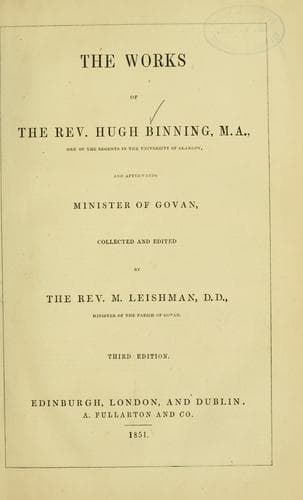
Presbyterian Church -- Sermons; Sermons, English; Theology -- Early works to 1800; Theology -- History -- 17th century
blood of God and could be expiated by no other propitiation, you would not
think it so easy to satisfy God with some words of custom, and some public
services of form, as you do, you would not for all the world deal with God
alone without this Mediator. And being convinced of sin, if you believe
this solidly, that he in whom forgiveness of sin and salvation is preached
is the same Lord God whom you hear in the Old Testament, who gave out the
law, and inspired the prophets,—the Only Begotten of the Father, in a way
infinitely removed from all created capacities,—you could not but find the
Father well satisfied in him and find a sufficient ransom in his death and
doings to pacify God, and to settle your consciences.
But as the thing testified is a matter of great consolation, so the
witnesses testifying to this fundamental of our religion may be a ground
of great encouragement to discouraged souls. It is ordinary, that the
apprehensions of Christians take up Jesus Christ as very lovely, and more
loving than any of the persons of the Godhead, either the Father or the
Holy Ghost. There are some thoughts of estrangedness and distance of the
father, as if the Son did really reconcile and gain him to love us, who
before hated us and upon this mistake, the soul is filled with continual
jealousies and suspicions of the love of God. But observe I beseech you,
the Father, the Son, and the Holy Ghost, all of them first agreeing in one
testimony. The Father declares from heaven that he is abundantly well
pleased with his Son, not only because he is his Son, but even in the
undertaking and performing of that work of redemption of sinners. It is
therefore his most serious invitation and peremptory command to all to
hear him, and believe in him, Mat. iii. 17, John iii. 23. Nay, if we speak
more properly, our salvation is not the business of Christ alone, as we
imagine it, but the whole Godhead is interested in it deeply, and so
deeply, that you cannot say who loves it most or likes it most. The Father
is the very fountain of it, his love is the spring of all—“God so loved
the world, that he gave his only begotten Son.” Christ hath not purchased
that eternal love to us, but is rather the gift, the free gift of eternal
love. And therefore, as we have the Son delighting among the sons of men,
Prov. viii. 31, and delighting to be employed and to do his will, Psal.
xl. 8, so we have the Father delighting to send his Son, and taking
pleasure in instructing him and furnishing him for it, Isa. xlii. 1. And
therefore Christ often professed that he was not about his own work, but
the Father’s work who sent him, and that it was not his own will, but his
Father’s he was fulfilling. Therefore we should not look upon the head
spring of our salvation in the Son but rather ascend up to the Father,
whose love and wisdom did frame all this. And thus we may be confident to
come to the Father in the Son, knowing that it was the love of the Father
Public-domain text, read in full here on John Shaqi.
Reviews
Reviews
No reviews yet
Be the first to share your thoughts on this work.
Elsewhere in the archive
Join the Discussion
Join the discussion
Sign in to leave a comment or review.
Sign InorCreate an account