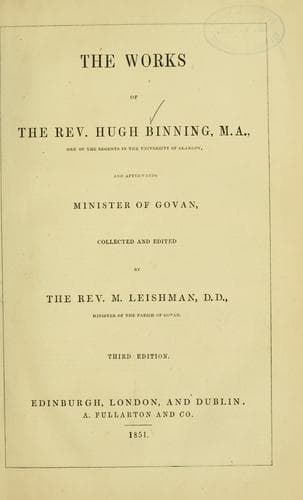
Presbyterian Church -- Sermons; Sermons, English; Theology -- Early works to 1800; Theology -- History -- 17th century
blessed Trinity, and while you worship that Holy Trinity, you may
straightway be reduced to an unity. To this wonderful and holy One,
Father, Son, and Holy Ghost, be all praise and glory.
Lecture XIV.
Of The Decrees Of God.
Eph. i. 11.—“Who worketh all things after the counsel of his own
will.”—Job xxiii. 13. “He is in one mind, and who can turn him?
and what his soul desireth, even that he doeth.”
Having spoken something before of God, in his nature and being and
properties, we come, in the next place, to consider his glorious majesty,
as he stands in some nearer relation to his creatures, the work of his
hands. For we must conceive the first rise of all things in the world to
be in this self-being, the first conception of them to be in the womb of
God’s everlasting purpose and decree, which, in due time, according to his
appointment, brings forth the child of the creature to the light of actual
existence and being. It is certain that his majesty might have endured for
ever, and possessed himself without any of these things. If he had never
resolved to create any thing without himself, he had been blessed then, as
now, because of his full and absolute self-sufficient perfection. His
purposing to make a world, and his doing of it, adds nothing to his inward
blessedness and contentment. This glorious and holy One encloses within
his own being all imaginable perfections, in an infinite and transcendent
manner, that if you remove all created ones, you diminish nothing, if you
add them all, you increase nothing. Therefore it was in the superabundance
of his perfection, that he resolved to show his glory thus in the world.
It is the creature’s indigence and limited condition which maketh it
needful to go without its own compass, for the happiness of its own being.
Man cannot be happy in loving himself. He is not satisfied with his own
intrinsic perfections, but he must diffuse himself by his affections and
desires and endeavours, and, as it were, walks abroad upon these legs, to
fetch in some supply from the creature or Creator. The creature is
constrained out of some necessity thus to go out of itself, which speaks
much indigence and want within itself. But it is not so with his majesty.
His own glorious Being contents him; his happiness is to know that, and
delight in it, because it comprehends in itself all that is at all
possible, in the most excellent and perfect manner that is
conceivable,—nay, infinitely beyond what can be conceived by any but
himself. So he needs not go without himself to seek love or delight, for
it is all within him, and it cannot be without his own Being, unless it
flow from within him. Therefore ye may find in Scripture what complacency
God hath in himself, and the Father in the Son, and the Son in the Father.
We find, Prov. viii., how the wisdom of God, our Lord Jesus, was the
Father’s delight from all eternity, and the Father again his delight, for
Public-domain text, read in full here on John Shaqi.
Reviews
Reviews
No reviews yet
Be the first to share your thoughts on this work.
Elsewhere in the archive
Join the Discussion
Join the discussion
Sign in to leave a comment or review.
Sign InorCreate an account