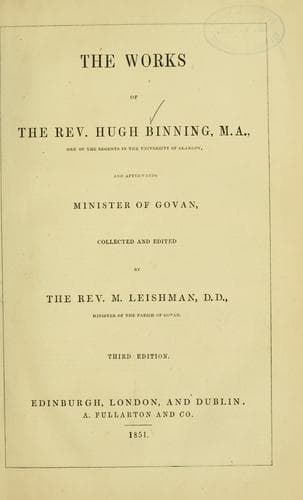
Presbyterian Church -- Sermons; Sermons, English; Theology -- Early works to 1800; Theology -- History -- 17th century
must be done not all at once, but one before another, either as their own
nature requires, or as he pleases. The very nature of the thing requires
that man be created before he sin; that he sin and fall before a Mediator
suffer for his sin; that he have a being before he have a glorious being;
and that he have a sinful and miserable being, before he have this
glorious and gracious being which may manifest the grace and mercy of God.
But it is the pleasure of the Lord that determines in what time and order
Christ shall suffer, either before or after the conversion of sinners, or
whether sinners shall be presently instated in glory, and perfectly
delivered from all sin at their first conversion, or only in part during
this life.
Seeing then this was his majesty’s purpose, to make so many vessels of
honour, upon whom he might glorify the riches of his grace and mercy; and
so many “vessels of wrath,” upon whom he might show the power of his
anger; you may think what needed all this business of man’s redemption.
Might not God have either preserved so many as he had appointed to glory
from falling into sin and misery; or at least have freely pardoned their
sin without any satisfaction; and out of the exceeding riches of his mercy
and power, have as well not imputed sin to them at all, as imputed their
sins to Christ, who was not guilty? What needed his giving so many to the
Son, and the Son’s receiving them? What needed these mysteries of
incarnation, of redemption, seeing he might have done all this simply
without so much pains and expense? Why did he choose this way? Indeed,
that is the wonder; and if there were no more end for it, but to confound
mortality that dare ask him what he doth, it is enough. Should he be
called down to the bar of human reason, to give an account of his matters?
“Who hath known the mind of the Lord, or, being his counsellor, hath
taught him,” that is in the depths of his unsearchable understanding, that
he chose to go this round, and to compass his end by such a strange
circuit of means, when he might have done it simply and directly without
so much pains? Yet it is not so hidden, but he hath revealed as much as
may satisfy or silence all flesh. For we must consider, that his great
project is not simply to manifest the glory of his goodness, but of his
gracious and merciful goodness, the most tender and excellent of all; and
therefore man must be miserable, sinful, and vile, that the riches of his
grace may appear in choosing and saving such persons. But that it may
appear also how excellent he could make man, and how vain all created
perfections are, being left to themselves, therefore he first made man
righteous, and being fallen into sin and misery, he might straightway have
restored him without more ado. But his purpose was to give an exact
demonstration of mercy, tempered and mixed with justice; and therefore he
finds out the satisfaction in his eternal counsel, “I have found a
Public-domain text, read in full here on John Shaqi.
Reviews
Reviews
No reviews yet
Be the first to share your thoughts on this work.
Elsewhere in the archive
Join the Discussion
Join the discussion
Sign in to leave a comment or review.
Sign InorCreate an account