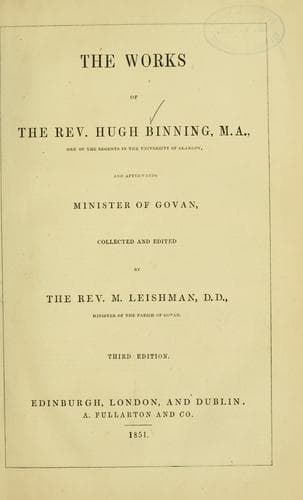
Presbyterian Church -- Sermons; Sermons, English; Theology -- Early works to 1800; Theology -- History -- 17th century
There is another whispering and suggestion of the wicked hearts of men
against the predestination of God, which insinuates that God is an
accepter of persons, and so accuses him of partial and unrighteous
dealing, because he deals not equally with all men. Do ye not say this
within yourselves—If he find all guilty, why does he not punish all? Why
does he spare some? And if ye look upon all men in his first and primitive
thought of them, as neither doing good nor evil, why does he not have
mercy on all? But is thine eye evil because he is good? May he not do with
his own as he pleases? Because he is merciful to some souls, shall men be
displeased, and do well to be angry? Or, because he, of his own free
grace, extends it, shall he be bound by a rule to do so with all? Is not
he both just and merciful, and is it not meet that both be showed forth?
If he punish thee, thou canst not complain, for thou deservest it, if he
show mercy, why should any quarrel, for it is free and undeserved grace.
By saving some, he shows his grace; by destroying others, he shows what
all deserve. God is so far from being an accepter of persons according to
their qualifications and conditions, that he finds nothing in any creature
to cast the balance of his choice. If he did choose men for their works’
sake, or outward privileges, and refuse others for the want of these, then
it might be charged on him, but he rather goes over all these, nay, he
finds none of these. In his first view of men he beholds them all alike,
and nothing to determine his mind to one more than another, so that his
choice proceedeth wholly from within his own breast,—“I will have mercy on
whom I will.” But then, thirdly, Our hearts object against the
righteousness of God, that this fatal chain of predestination overturns
all exhortations and persuasions to godliness, all care and diligence in
well-doing. For thus do many profane souls conceive—If he be in one mind,
who can turn him? Then, what need I pray, since he has already determined
what shall be, and what shall become of me? His purpose will take effect
whether I pray or pray not; my prayer will not make him change his mind,
and if it be in his mind he will do it, if he hath appointed to save us,
saved we shall be, live as we list; if he hath appointed us to death, die
we must, live as we can. Therefore men, in this desperate estate, throw
themselves headlong into all manner of iniquity, and that with quietness
and peace. Thus do many souls perish upon the stumbling-stone laid in
Zion, and wrest the truths and counsels of God to their own destruction,
even quite contrary to their true intent and meaning. Paul, (Eph. i. 4 )
speaks another language—“He hath chosen us in him,—that we should be holy
and without blame.” His eternal counsel of life is so far from loosing the
reins to men’s lusts, that it is the only certain foundation of holiness;
it is the very spring and fountain from whence our sanctification flows by
an infallible course.
Public-domain text, read in full here on John Shaqi.
Reviews
Reviews
No reviews yet
Be the first to share your thoughts on this work.
Elsewhere in the archive
Join the Discussion
Join the discussion
Sign in to leave a comment or review.
Sign InorCreate an account