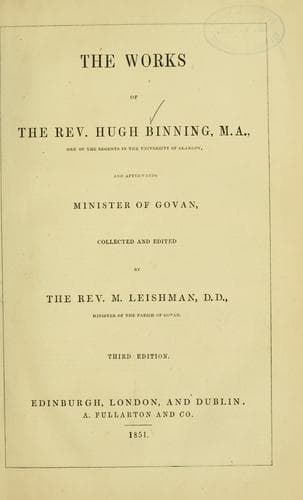
Presbyterian Church -- Sermons; Sermons, English; Theology -- Early works to 1800; Theology -- History -- 17th century
The second objection Paul mentions, tends to justify men. “Why then doth
he yet find fault? For who hath resisted his will?” Since by his will he
hath chained us with an inevitable necessity to sin, what can we do? Men
cannot wrestle with him, why then doth he condemn and accuse them? “But
who art thou, O man, who disputest against God?” As if Paul had said, thou
art a man, and so I am, why then lookest thou for an answer from me? Let
us rather both consider whom we speak of, whom thou accusest, and whom I
defend. It is God; what art thou then to charge him, or what am I so to
clear him? Believing ignorance is better than presumptuous knowledge,
especially in those forbidden secrets in which it is more concerning to be
ignorant with faith and admiration, than to know with presumption. Dispute
_thou_, O man, _I_ will wonder, reply _thou_, _I_ will believe! Doth it
become thee, the clay, to speak so to thy Former, “Why hast thou made me
thus?” Let the consideration of the absolute right and dominion of God
over us,—more than any creature hath over another, yea, or over
themselves,—let that restrain us, and keep us within bounds. He may do
with us what he pleaseth, for his own honour and praise, but it is his
will that we should leave all the blame to ourselves, and rather behold
the evident cause of our destruction in our sin, which is nearer us, than
to search into a secret and incomprehensible cause in God’s counsel.
Lecture XVII.
Of Creation
Heb. xi. 3.—“Through faith we understand that the worlds were
framed by the word of God, so that things which are seen were not
made of things which do appear.”—Gen. i. 1. “In the beginning God
created the heaven and the earth.”
We are come down from the Lord’s purposes and decrees to the execution of
them, which is partly in the works of creation and partly in the works of
providence. The Lord having resolved upon it to manifest his own glory did
in that due and predeterminate time apply his own power to this business.
Having in great wisdom conceived a frame of the world in his mind from all
eternity, he at length brings it forth, and makes it visible. We shall not
insist upon the particular story of it, as it is set down in general, but
only point at some things for our instruction.
Public-domain text, read in full here on John Shaqi.
Reviews
Reviews
No reviews yet
Be the first to share your thoughts on this work.
Elsewhere in the archive
Join the Discussion
Join the discussion
Sign in to leave a comment or review.
Sign InorCreate an account