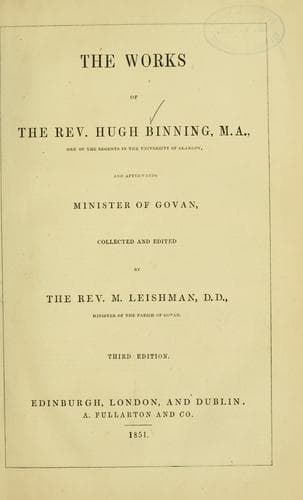
Presbyterian Church -- Sermons; Sermons, English; Theology -- Early works to 1800; Theology -- History -- 17th century
But that which the Lord looks most into in this work, and would have us
most to consider, is that image of himself that he did imprint on
man,—“Let us make man in our own image.” There was no creature but it had
some engravings of God upon it, some curious draughts and lineaments of
his power, wisdom, and goodness upon it, and therefore the heavens are
said to show forth his glory, &c. But whatever they have, it is but the
lower part of that image, some dark shadows and resemblances of him, but
that which is the last of his works, he makes it according to his own
image, _tanquam ab ultima manu_. He therein gives out himself to he read
and seen of all men as in a glass. Other creatures are made as it were
according to the similitude of his footstep,—_ad similitudinem
vestigii_,—but man _ad similitudinem faciei_,—according to the likeness of
his face,—“in our image, after our likeness.” It is true there is only
Jesus Christ his Son, who is “the brightness of his glory, and the express
substantial image of his person,” who resembles him perfectly and
thoroughly in all properties, so that he is _alter idem_, another self
both in nature, properties, and operations,—so like him that he is one
with him, so that it is rather an _oneness_, than a likeness. But man he
created according to his own image, and gave him to have some likeness to
himself,—likeness I say, not _sameness_ or _oneness_. That is high indeed,
to be like God. The notion and expression of it imports some strange
thing. How could man be like God, who is infinite, incomprehensible, whose
glory is not communicable to another? It is true, indeed, in those
incommunicable properties he hath not only no equal, but none to liken
him. In these he is to be adored, and admired as infinitely transcending
all created perfections and conceptions, But yet in others he has been
pleased to hold forth himself to be imitated and followed. And that this
might be done, he first stamps them upon man in his first moulding of him.
And if ye would know what these are particularly, the apostle expresses
them, “in knowledge,” (Col. iii. 10) “in righteousness and true holiness,”
Eph. iv. 21. This is the “image of him who created him,” which the Creator
stamped on man, that he might seek him, and set him apart for himself to
keep communion with him, and to bless him. There is a spirit given to man
with a capacity to know and to will, and here is a draught and lineament
of God’s face which is not engraven on any sensitive creature. It is one
of the most noble and excellent operations of life, in which a man is most
above beasts, to reflect upon himself and to know himself and his Creator.
There are natural instincts given to other things, natural propensions to
those things that are convenient to their own nature, but none of them
have so much as a capacity to know what they are, or what they have. They
cannot frame a notion of him who gave them a being but are only
Public-domain text, read in full here on John Shaqi.
Reviews
Reviews
No reviews yet
Be the first to share your thoughts on this work.
Elsewhere in the archive
Join the Discussion
Join the discussion
Sign in to leave a comment or review.
Sign InorCreate an account