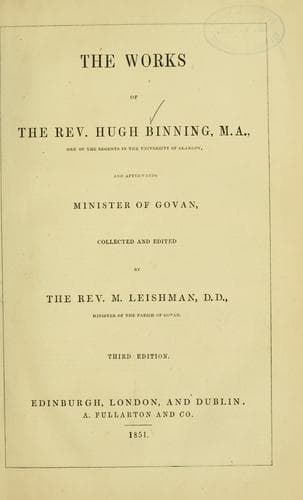
Presbyterian Church -- Sermons; Sermons, English; Theology -- Early works to 1800; Theology -- History -- 17th century
one, Go, and he goeth, and to another, Come, and he cometh, sending out
love one way, holy hatred another way. These were as wings to the bird to
flee upon, as wheels to the chariot to run upon, though now it be turned
just contrary, that the chariot draws the coachman, because the motion is
downward. There could be no motion in an upright man’s soul till the holy
and righteous will gave out a sentence upon it. That was the _primum
mobile_ which was turned about itself by such an _intelligentia_ as the
understanding. And so it was in Christ,—affection could not move him, but
he did move his own affections, he troubled himself. In us the servant
rides on horses, and the prince walks on foot, even as in a distempered
society, the laws and ordinances proceed by an unnatural way from the
violence of unruly subjects usurping over their masters. Holy and
righteous man could both raise up his affections, and compose them again,
they were under such nurture and discipline. He could have said, Hitherto,
and no further, in which there was some resemblance of God ruling the
raging and unruly sea. But now, if once they get entry into our city, they
are more powerful than the governor, and will not take laws from him, but
give him rather. When we have given way to our passions, they do next what
they please, not what we permit.
Next his excellency consisted in such an immunity and freedom from all
fear of misery and danger, from all touch of sorrow or pain, and did enjoy
such a holy complacency and delight in his own estate, as made him
completely happy. In this he was like God. This is his blessedness, that
he is absolutely well pleased in himself, that he is without the reach of
fear and danger, that none can impair it, none can match it. “I am God and
none else,” that is sufficiency of delight to know himself, and his own
sufficiency. Indeed, man was made changeable, mutably good, that in this
he might know God was above him, and so might have ground of watchfulness
and dependence upon him for continuance of his happiness who made him
happy. But being made so upright, no disquieting fear nor perplexing care
could trouble him. Then lastly, if you add unto this, holy satisfaction
with his own state and freedom, the dominion and sovereignty he had over
the creatures as a consequent flowing from that image, you may imagine
what a happy creature he was. Whatsoever contentment or satisfaction the
creatures could afford, all of them willingly and pleasantly would concur
to bestow it upon man, without his care or toil, as if they had accounted
it then happiness to serve him. What more excellent than this order? Man
counting it his happiness and delight to serve God and creatures esteeming
it their happiness to serve man, all things running towards him with all
their goodness, as to a common centre, and he returning all to God, from
whence they did immediately flow. Thus, besides the fulness and riches of
Public-domain text, read in full here on John Shaqi.
Reviews
Reviews
No reviews yet
Be the first to share your thoughts on this work.
Elsewhere in the archive
Join the Discussion
Join the discussion
Sign in to leave a comment or review.
Sign InorCreate an account