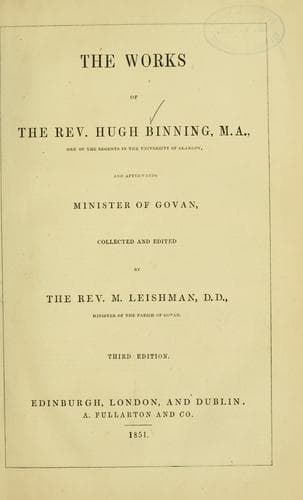
Presbyterian Church -- Sermons; Sermons, English; Theology -- Early works to 1800; Theology -- History -- 17th century
comfort, and liberty, we do not obey him because he commands, but for our
own sakes. It is the practice of Antinomians, and contrary to true
godliness, to look upon the law of God as the creature’s bondage, as most
of us do in our walking. A Christian, in whom the image of God is renewed
according to righteousness and holiness, should esteem subjection and
conformity to a law, and to the will of God, his only true liberty, yea,
the very beauty of the soul; and never is a soul advanced in conformity to
God, till this be its delight, not a burden or task.
Lecture XXII.
Of The First Covenant.
Gal. iii. 12.—“The law is not of faith; but the man that doeth
them shall live in them.”—Gen. ii. 17.—“But of the tree of the
knowledge of good and evil, thou shalt not eat of it; for in the
day that thou eatest thereof, thou shalt surely die.”
The Lord made all things for himself, to show forth the glory of his name;
and man in a more eminent and special manner, for more eminent
manifestations of himself; therefore all his dealings towards men, whether
righteous or sinful, do declare the glory of God. Particularly, in
reference to the present purpose, he resolved to manifest two shining
properties,—his sovereignty and goodness. His sovereignty is showed, in
giving out a law and command to the creature; and his goodness is
manifested in making a covenant with his creature; as here you see the
terms of a covenant, a duty required, and a promise made, and, in case of
failing, a threatening conformed to the promise. He might have required
obedience simply, as the Lord and sovereign owner of the being and
operations of the creatures; and that was enough of obligation to bind all
flesh, that the Creator is lawgiver, that he who gives a being doth set
bounds and limits to the exercise and use of that being. But it pleased
the Lord, in his infinite goodness and love, to add a promise and
threatening to that law and command, and so turns it to the nature of a
voluntary covenant and agreement, whereby he doth mitigate and sweeten his
authority and power, and condescends so low to man as to take on himself a
greater obligation than he puts upon man, “Do this, and thou shalt live.”
He might then, out of his absoluteness and power, have required at the
creature’s hand any terms he pleased, even the hardest which could be
imagined, and yet no injustice in him. He might have put laws on men to
restrain all their natural liberty, and in every thing, to proclaim
nothing but his own supremacy. But O what goodness and condescension is
even in the very matter of the law; and then in the manner of prescribing
it with a promise! In the matter, so just and equitable to convince all
men’s consciences, yea, even engraven on their hearts, that he lays not
many burdens on, but what men’s consciences must lay on themselves; that
there is nothing in it all, when summed up, harder than this,—love God
Public-domain text, read in full here on John Shaqi.
Reviews
Reviews
No reviews yet
Be the first to share your thoughts on this work.
Elsewhere in the archive
Join the Discussion
Join the discussion
Sign in to leave a comment or review.
Sign InorCreate an account